

Methamphetamine was involved in 31.2 percent of US overdose deaths recorded in recent CDC surveillance. No medication has been approved to treat methamphetamine use disorder. The treatment with the strongest evidence is a behavioral approach that federal funding rules capped for years, and the cap was only lifted in 2025.
The approval gap
For opioid use disorder there are three approved medications. For alcohol use disorder there are three. For methamphetamine use disorder there are none. NIDA director Nora Volkow put it plainly in a 2021 statement accompanying trial results: unlike for opioids, there are currently no approved medications for treating methamphetamine use disorder.
That absence shapes everything downstream. There is no prescription to write, no medication to bill for, no formulary to negotiate, and no equivalent of the buprenorphine access debate. The clinical conversation is about behavioral treatment, and the policy conversation is about how behavioral treatment gets paid for.
What the ADAPT-2 trial found
The most cited attempt at a pharmacological answer is ADAPT-2, run through the NIDA Clinical Trials Network between 2017 and 2019 and published in the New England Journal of Medicine in January 2021. It enrolled 403 adults aged 18 to 65 with moderate to severe methamphetamine use disorder and tested extended release injectable naltrexone given every three weeks, combined with 450 milligrams of daily extended release oral bupropion, against matched placebo.
Response was defined as at least three of four negative urine screens. At weeks five and six, 16.5 percent of the treatment group responded against 3.4 percent on placebo. At weeks 11 and 12 the figures were 11.4 percent and 1.8 percent. The weighted average across stages was 13.6 percent against 2.5 percent, an overall treatment effect of 11.1 percentage points. The number needed to treat was nine. Researchers reported no significant adverse effects, with adherence of 77.4 percent in the treatment arm and 82.0 percent on placebo over the final six weeks.
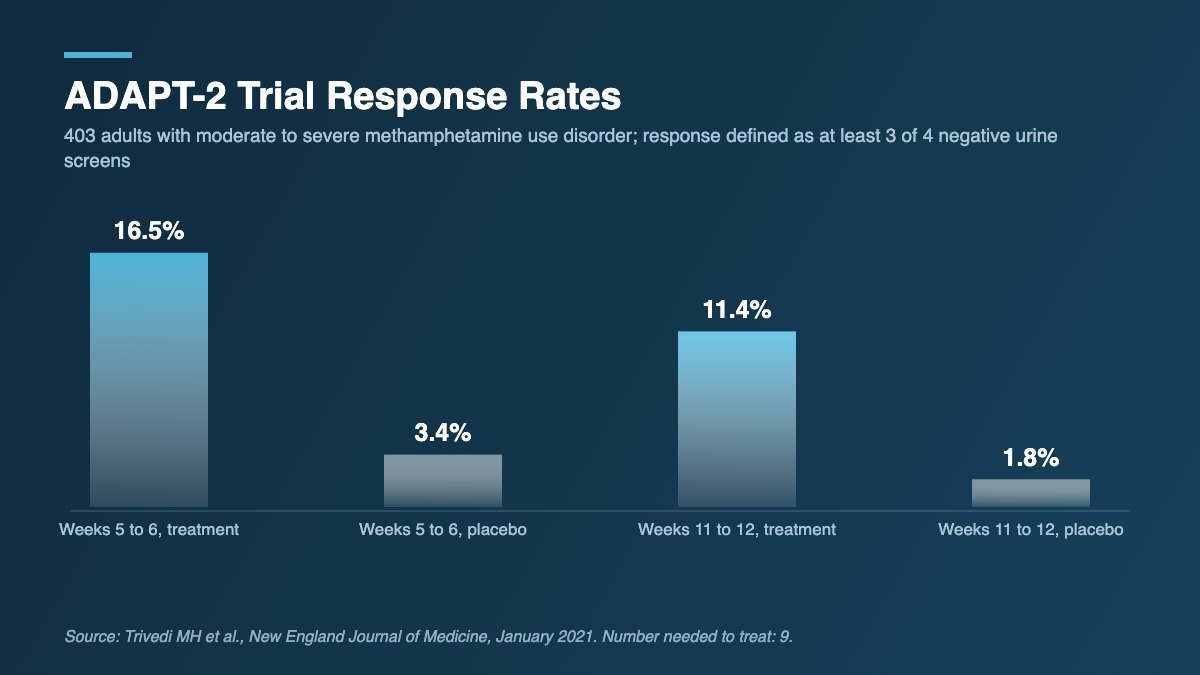
Read carefully, this is a real effect and a modest one. A number needed to treat of nine means eight people take the combination without meeting the response threshold for every one who does. It is also worth noting that both drugs in the combination are already approved for other uses, which means clinicians can prescribe them off label today without waiting for a new approval.
Contingency management and the incentive cap
The treatment with the strongest evidence base for stimulant use disorder is not a drug. Contingency management provides tangible rewards for verified abstinence, typically through urine testing two or three times a week over about 12 weeks. NIDA has described it as the most effective therapy for stimulant use disorders, and the 2024 clinical practice guideline from the American Society of Addiction Medicine and the American Academy of Addiction Psychiatry identifies it as the standard of care.
Its adoption was limited by a funding rule. NIDA noted in 2021 that use was constrained in part by a policy limiting the monetary value of incentives allowable as part of treatment. For SAMHSA funded programs that cap sat at 75 dollars per person per year, well below the amounts the research literature associates with benefit. Published work points to totals in the range of 400 to 560 dollars, with larger reductions in use at higher amounts, and typical individual rewards from about 5 dollars to more than 16.
In January 2025 SAMHSA raised the cap tenfold, to 750 dollars per person per year, with no limit on individual incentive size. Cash is not permitted; programs must use items, vouchers or gift cards.
Where the death data stands
Deaths involving psychostimulants with abuse potential, a category dominated by methamphetamine, rose from 5,716 in 2015 to 34,855 in 2023, then fell to 28,722 in 2024, an age adjusted decline of 19.8 percent. About 70 percent of stimulant involved deaths also involve illicitly manufactured fentanyl, which means a substantial share of what gets counted as methamphetamine mortality is driven by opioid co involvement. See our methamphetamine reference page and drug information library for background.
Takeaways
- No medication is approved for methamphetamine use disorder. Three are approved for opioid use disorder and three for alcohol use disorder.
- ADAPT-2 found injectable naltrexone plus extended release bupropion beat placebo by about 11 percentage points, with a number needed to treat of nine.
- Both drugs in that combination are already approved for other indications, so off label prescribing is possible now.
- Contingency management has the strongest evidence and is identified as standard of care in the 2024 ASAM and AAAP guideline.
- SAMHSA raised its incentive cap from 75 to 750 dollars per person per year in January 2025, closing a long standing gap between the research and the funding rules.
- Anyone weighing off label medication should discuss it with a prescribing clinician, since both drugs interact with other conditions and medications.
Sources
National Institutes of Health news release, January 2021, reporting Trivedi MH and colleagues, New England Journal of Medicine. American Society of Addiction Medicine and American Academy of Addiction Psychiatry, clinical practice guideline on the management of stimulant use disorder, 2024. The Pew Charitable Trusts, February 2025, reporting on SAMHSA guidance raising the contingency management incentive cap. National Center for Health Statistics Data Brief No. 549, January 2026. National Institute on Drug Abuse overdose statistics from CDC WONDER.
Need help now? In an emergency call 911. If you are in crisis or thinking about suicide, call or text 988 (Suicide and Crisis Lifeline; veterans press 1). For free, confidential treatment referrals 24 hours a day, call the SAMHSA National Helpline at 1-800-662-4357. You can also search licensed programs at FindTreatment.gov, or use our rehab directory and state listings.
Addiction Now publishes health journalism and reference material. This page is not medical advice, a diagnosis, or a treatment plan. Do not stop a prescribed medication without talking to a clinician. Withdrawal from alcohol, benzodiazepines and barbiturates can cause seizures and can be fatal without medical supervision.