

When cocaine and alcohol are taken together, the liver produces a third drug that neither one was. It is called cocaethylene, it lasts roughly twice as long as cocaine, and researchers describe it as the only known instance of a new psychoactive substance formed entirely within the human body. Alcohol is co-ingested in about a third of cocaine related emergency department visits.
How it forms
Cocaine is normally broken down by enzymes called carboxylesterases, mainly in the liver, through hydrolysis with water. That produces benzoylecgonine and ecgonine methyl ester, both inactive.
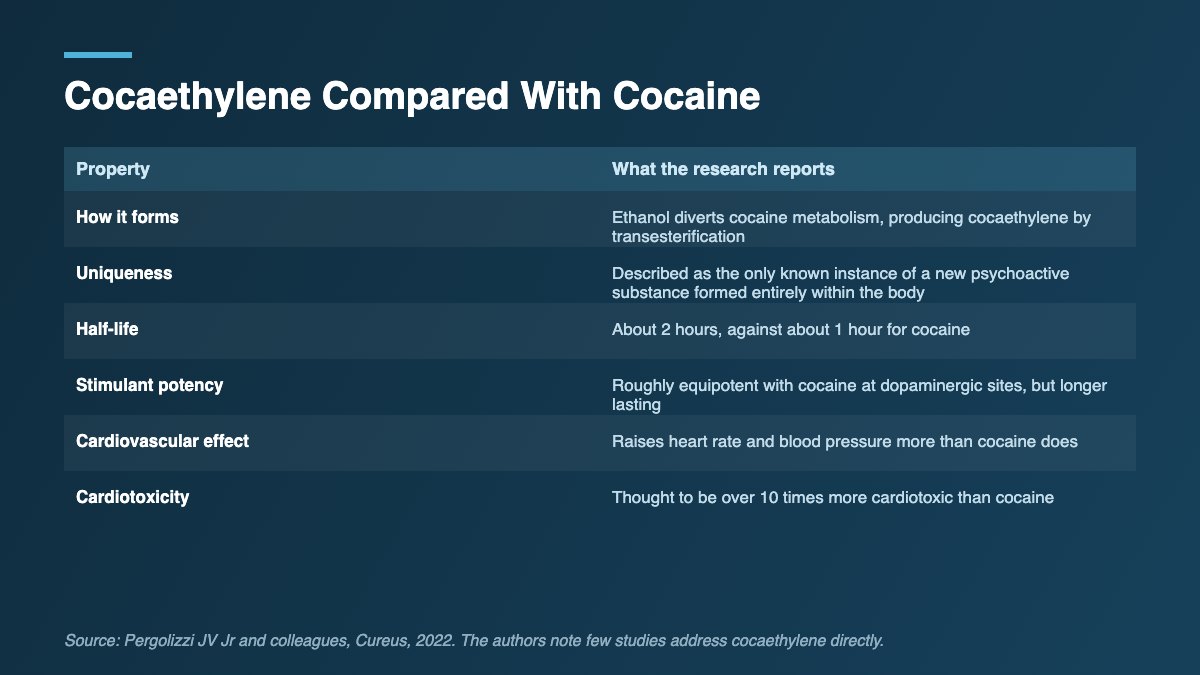
Add ethanol and the pathway changes. Instead of hydrolysis with water, some of the cocaine undergoes transesterification with ethanol, producing cocaethylene. Chemically, cocaine is the methyl ester of benzoylecgonine and cocaethylene is the ethyl ester.
The critical point is what the ethanol displaces. It diverts cocaine metabolism away from the inactive benzoylecgonine metabolite and toward the active cocaethylene metabolite. Drinking does not dilute the cocaine; it redirects part of it into something that stays active longer.

Why the high lasts longer
Cocaethylene has a half-life of about 2 hours against roughly 1 hour for cocaine, with slower clearance, a larger volume of distribution and a longer elimination half-life.
At dopaminergic sites its stimulant potency is roughly equipotent with cocaine, but the longer half-life makes its effects more persistent. That is the pharmacological explanation for something people who combine the two describe experientially: the high feels smoother and longer.
The prolonged effect is precisely the problem. A longer window of stimulant action means a longer window of cardiovascular strain.
What the cardiac evidence shows
Cocaethylene raises heart rate and blood pressure more than cocaine does, and is a more potent sodium channel blocker than cocaine. Reviewers describe it as thought to be over 10 times more cardiotoxic than cocaine.
The strongest clinical data comes from a 2023 emergency department study of 199 patients with acute drug overdose, 150 with cocaine only and 49 with cocaethylene present. Cardiac arrest occurred in 3 of 49 in the cocaethylene group, 6.12 percent, against 1 of 150 in the cocaine only group, 0.67 percent. The adjusted odds ratio for cardiac arrest was 12.61, with a 95 percent confidence interval of 1.10 to 144.18, adjusted for age, race, sex and history of coronary artery disease. The cocaethylene group also had higher initial lactate and higher initial troponin.
That confidence interval is very wide, spanning from barely elevated to enormously elevated, because the numbers of events are small. The finding points clearly in one direction while leaving the magnitude uncertain, and it should be read that way.
We should also flag what we are not telling you. A widely circulated claim that cocaethylene carries an 18 to 25 fold increase in risk of sudden death appears in a great deal of published material. We could not trace it to any authoritative source and are not repeating it. The odds ratio above, with its interval stated, is the figure that holds up.
The reviewers themselves add a caution worth carrying: there are few studies specifically addressing cocaethylene, and the acute cardiotoxic effects of cocaethylene in humans are not known with precision.
The detection detail
Because cocaethylene has a longer half-life than cocaine, its measurable presence in blood indicates that the person used cocaine even when cocaine itself is no longer detectable. Its presence is also proof that alcohol was involved, since it cannot form without ethanol.
For anyone reading a toxicology report, cocaethylene is therefore a marker of two things at once: cocaine use, and drinking alongside it.
Why the scale matters
Cocaine use results in over 500,000 emergency department visits annually in the United States, and ethanol co-ingestion is reported in 34 percent of them. This is not a rare or exotic combination. It is roughly one in three cocaine related emergency visits.
Combining the two is also common precisely because alcohol blunts some of cocaine’s unpleasant effects and cocaine offsets alcohol’s sedation, which makes people feel more capable than they are. The subjective smoothing and the objective cardiac strain move in opposite directions.
See our cocaine page, alcohol page and drug information library for related material.
Takeaways
- Cocaine plus alcohol produces cocaethylene, a new active substance formed in the body.
- Cocaethylene has roughly double cocaine’s half-life, which prolongs both the high and the cardiac strain.
- It raises heart rate and blood pressure more than cocaine and is described as over 10 times more cardiotoxic.
- An emergency department study found an adjusted odds ratio of 12.61 for cardiac arrest, with a wide confidence interval of 1.10 to 144.18.
- The often quoted 18 to 25 fold sudden death figure does not trace to a verifiable source and should not be relied on.
- Alcohol is co-ingested in about 34 percent of the more than 500,000 annual cocaine related emergency visits.
Sources
Pergolizzi JV Jr and colleagues, Cocaethylene: When Cocaine and Alcohol Are Taken Together, Cureus, 2022. Shastry S, Manoochehri O, Richardson LD, Manini AF, Cocaethylene cardiotoxicity in emergency department patients with acute drug overdose, Academic Emergency Medicine, 2023.
Need help now? In an emergency call 911. If you are in crisis or thinking about suicide, call or text 988 (Suicide and Crisis Lifeline; veterans press 1). For free, confidential treatment referrals 24 hours a day, call the SAMHSA National Helpline at 1-800-662-4357. You can also search licensed programs at FindTreatment.gov, or use our rehab directory and state listings.
Addiction Now publishes health journalism and reference material. This page is not medical advice, a diagnosis, or a treatment plan. Do not stop a prescribed medication without talking to a clinician. Withdrawal from alcohol, benzodiazepines and barbiturates can cause seizures and can be fatal without medical supervision.