


Litigation against opioid manufacturers, distributors and pharmacies produced more than 50 billion dollars flowing to states, counties and cities over roughly two decades. Since 2022, nearly every jurisdiction has set up a formal body to decide how that money is used. What remains difficult, four years in, is finding out where it actually went.
How the money moves
The settlements are not a single check. Payments arrive in annual installments stretched across many years, and each state splits its share according to its own agreement: some portion to the state government, some to counties and municipalities, and often some to a dedicated trust or council that awards grants. That structure was designed to prevent a repeat of the 1998 tobacco master settlement, where large sums were absorbed into general funds and spent on things unrelated to smoking.
The safeguard most agreements use is a requirement that funds go to opioid remediation, usually defined through a list of approved uses covering treatment, recovery support, harm reduction, prevention and related infrastructure. The safeguard most agreements lack is a uniform, public, itemized accounting of what was bought.
The transparency gap
The most complete public picture of early spending was assembled by journalists rather than by government. KFF Health News built a database documenting how state and local governments used settlement money in 2022 and 2023, cataloging more than 10,500 examples. The National Academy for State Health Policy separately tracks state-level spending plans and decisions, and the National Association of Counties has published guidance on what transparent fund management should look like.

The existence of those three efforts is itself the finding. If the official record were consistently itemized and published, none of them would need to compile it.
In practice, disclosure varies enormously. Some states publish searchable dashboards with grant-level detail. Others report at the level of a category and a total. Many counties, which in several states control a large share of the money, publish nothing beyond a line in a budget document.
What states are allocating now
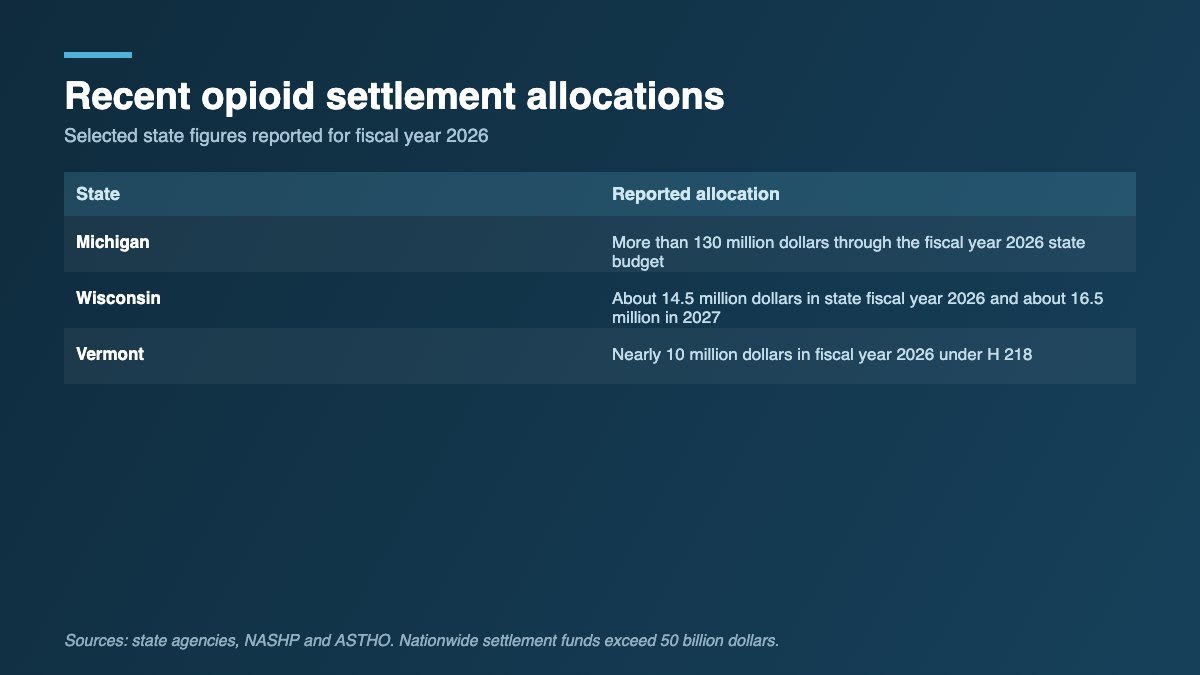
Recent state figures give a sense of the annual scale. Michigan has taken a statewide budgeting approach, allocating more than 130 million dollars through its fiscal year 2026 budget. Wisconsin expects about 14.5 million dollars in state fiscal year 2026 and about 16.5 million in fiscal year 2027. Vermont passed H 218, directing nearly 10 million dollars in fiscal year 2026 toward prevention, treatment, recovery and overdose prevention work.
These are allocations, which is not the same as expenditures. Money can be appropriated in one fiscal year, awarded in the next, and spent over three more. That lag is normal in public finance and it is also the main reason simple questions about settlement spending are hard to answer quickly.
The supplant question
The recurring concern among public health researchers is substitution: settlement dollars paying for services that a state was already funding, freeing existing money for other purposes. The net effect on treatment capacity would then be zero, even though every dollar was technically spent on an approved use.
Detecting substitution requires knowing what baseline spending was before the settlements arrived, and comparing it year over year. Very few jurisdictions publish data in a form that makes that comparison possible. This is why transparency advocates focus less on whether spending is allowed and more on whether it is additive.
How to find out what your state and county are doing
- Search for your state’s opioid settlement council, advisory board or trust. Most publish meeting agendas and minutes, which often contain more detail than the formal reports.
- Check whether your state has a public dashboard. Where one exists, look for grant-level records rather than category totals.
- Look at your county budget separately. In many states counties receive a substantial direct share and report independently of the state.
- Council and board meetings are usually open to the public, and public comment periods are where local programs make the case for funding.
- If records are not published, state public records laws apply to settlement expenditures the same way they apply to other public funds.
What to take from this
- More than 50 billion dollars is committed nationally, arriving in installments across roughly two decades rather than as a lump sum.
- Nearly all jurisdictions now have a governance structure; disclosure practices behind those structures differ widely.
- The fullest account of early spending came from journalism and policy groups, not from official reporting.
- Allocation figures and actual expenditures are different measures, and conflating them produces misleading conclusions.
- The substantive risk is substitution rather than misuse, and it is invisible without baseline comparisons.
For background on the substances at the center of this litigation, see our drug information library and the pages on fentanyl and oxycodone.
Sources
This article relies on reporting and tracking by KFF Health News, the National Academy for State Health Policy, the National Association of Counties, the Association of State and Territorial Health Officials, and published state budget and agency documents. Figures reflect amounts reported by those sources and are subject to revision.
Need help now? In an emergency call 911. If you are in crisis or thinking about suicide, call or text 988 (Suicide and Crisis Lifeline; veterans press 1). For free, confidential treatment referrals 24 hours a day, call the SAMHSA National Helpline at 1-800-662-4357. You can also search licensed programs at FindTreatment.gov, or use our rehab directory and state listings.
Addiction Now publishes health journalism and reference material. This page is not medical advice, a diagnosis, or a treatment plan. Do not stop a prescribed medication without talking to a clinician. Withdrawal from alcohol, benzodiazepines and barbiturates can cause seizures and can be fatal without medical supervision.