


All 50 states, the District of Columbia and three territories operate a prescription drug monitoring program. The research on whether they worked has a consistent finding that is usually lost in the summary: what mattered was not whether a state had a database, but whether prescribers were required to look at it.
Coverage, and the mandate question
As of August 2025, every state plus DC, Puerto Rico, Guam and the Northern Mariana Islands had an operational monitoring program. Universal coverage is a policy success in the narrow sense that the infrastructure exists everywhere.
The variation is in what prescribers must do with it. A 2020 legal dataset found 46 states and one territory had some form of requirement to check the database before prescribing, with wide variation in how stringent that requirement is: which drugs it covers, which prescribers, whether it applies to a first prescription or every refill, and what the consequence of not checking is. We could not find a reliable current count of mandate states more recent than that 2020 dataset, and would rather say so than cite a number we cannot source.
The finding that matters
Buchmueller and Carey, writing in the American Economic Journal: Economic Policy in 2018, examined Medicare Part D and separated states with must-access provisions from states that merely operated a database.

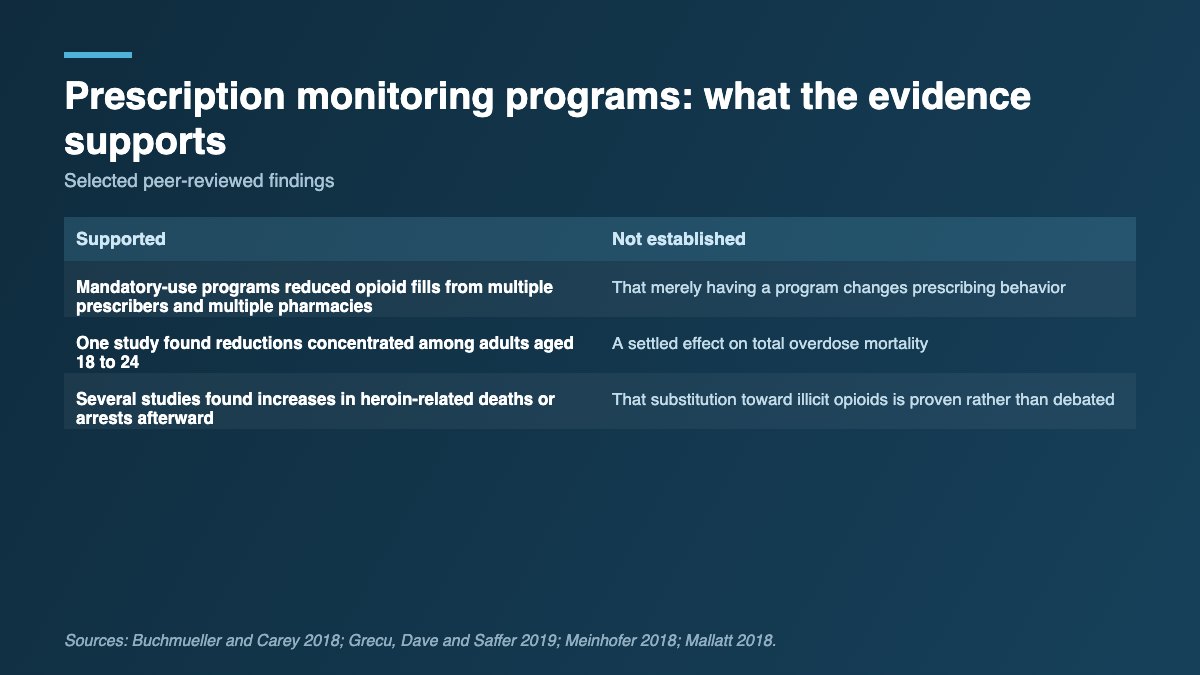
Must-access programs produced measurable change. The share of enrollees obtaining opioids from five or more prescribers fell about 8 percent, and from five or more pharmacies by more than 15 percent. Programs without a must-access requirement showed no measurable effect on the same outcomes.
Grecu, Dave and Saffer reached a compatible conclusion in the Journal of Policy Analysis and Management in 2019. Operational programs alone showed no substantial effect on substance use treatment admissions, while mandatory-access provisions were associated with a significant reduction in prescription drug misuse, concentrated among adults aged 18 to 24, alongside a complementary reduction in cocaine and marijuana admissions.
Two independent teams, two datasets, the same structural result: the mandate is the intervention. The database is only the mechanism.
The substitution question
This is where the literature gets uncomfortable, and where honest reporting requires holding two things at once.
Several studies found evidence consistent with people moving from prescription opioids to illicit ones as prescribing tightened. Meinhofer, using data through 2013, found suggestive evidence that must-access programs were associated with increased heroin-related overdose deaths, and flagged that the finding was sensitive to how the model was specified. Mallatt found monitoring programs associated with increased heroin-related arrests. A research synthesis identified three separate studies finding increases in heroin overdose deaths following prescribing restrictions of this kind.
What this does not amount to is a settled conclusion. The findings are study-dependent, several rely on proxies such as arrests rather than direct measures of use, and the period studied overlaps with the independent arrival of illicit fentanyl in the drug supply, which is a very large confounder. Anyone telling you monitoring programs caused the fentanyl era is overreading the evidence. Anyone telling you there was no substitution at all is ignoring it.
We also want to flag two figures circulating in secondary summaries that we could not trace to a named study: a claim that programs cut opioid prescriptions by 13 percent, and a paired claim about mandatory programs raising illicit opioid death rates by 19 percent. Neither had a locatable primary source, and neither should be cited.
What this means for a patient
Two practical consequences are worth knowing.
First, your prescription history for controlled substances is visible to prescribers and pharmacists in your state, and increasingly across state lines through data sharing. This is not secret, but patients are often surprised by it.
Second, if you have a legitimate prescription and are being refused a refill or treated with suspicion, the database record is a document you can ask about. Errors happen, particularly with similar names, and a prescriber can review the actual record with you rather than acting on an impression.
What to take from this
- Every state and DC operates a monitoring program. Universal coverage was achieved.
- Programs that require prescribers to check produced measurable reductions in multiple-prescriber and multiple-pharmacy opioid fills. Programs without that requirement did not.
- One study found the reduction in misuse concentrated among adults aged 18 to 24.
- Several studies found increases in heroin-related deaths or arrests afterward, consistent with substitution, but the finding is contested and confounded by the arrival of illicit fentanyl.
- Your controlled substance prescription history is visible to prescribers and pharmacists, and increasingly across state lines.
For background on the medications involved, see our drug information library and the pages on oxycodone and heroin.
Sources
This article relies on the Federation of State Medical Boards survey of state monitoring programs, Buchmueller and Carey in the American Economic Journal: Economic Policy (2018), Grecu, Dave and Saffer in the Journal of Policy Analysis and Management (2019), working papers by Meinhofer and by Mallatt, and research syntheses of the substitution literature. Where a widely repeated figure had no traceable source, we have said so.
Need help now? In an emergency call 911. If you are in crisis or thinking about suicide, call or text 988 (Suicide and Crisis Lifeline; veterans press 1). For free, confidential treatment referrals 24 hours a day, call the SAMHSA National Helpline at 1-800-662-4357. You can also search licensed programs at FindTreatment.gov, or use our rehab directory and state listings.
Addiction Now publishes health journalism and reference material. This page is not medical advice, a diagnosis, or a treatment plan. Do not stop a prescribed medication without talking to a clinician. Withdrawal from alcohol, benzodiazepines and barbiturates can cause seizures and can be fatal without medical supervision.