

Syringe services programs have one of the more settled evidence bases in drug policy. CDC states that nearly 30 years of research shows comprehensive programs are safe, effective and cost saving, and that they do not increase illegal drug use or crime. In April 2026 the federal government narrowed what its grant dollars may buy at those programs.
What the evidence shows
The headline findings, as stated by CDC, are these. Use of a syringe services program is associated with an estimated 50 percent reduction in HIV and hepatitis C incidence among people who inject drugs. When programs are combined with medication for opioid use disorder, the reduction exceeds two thirds.
Programs also function as an entry point to treatment rather than an alternative to it. Participants are cited as roughly five times more likely to enter drug treatment and about three times more likely to stop or reduce injecting than people who do not participate.
On the two objections raised most often locally, the research does not support either: program presence has not been found to increase neighborhood crime rates or unsafe syringe disposal.
How many there are, and where
As of March 2025, 37 states and the District of Columbia had laws explicitly or implicitly authorizing syringe services programs. More than 550 programs were operating across 45 states, DC and Puerto Rico, including 25 mobile units.
Five states had no operating program at all: Kansas, Mississippi, Nebraska, South Dakota and Wyoming. Seven states required participants to register, a condition that research on program uptake generally treats as a deterrent to the people hardest to reach.
The funding rule, and how it changed
Federal money has never paid for syringes. A ban ran from 1988 until a partial change in 2015 and 2016, and even after that change federal dollars could pay for staff, vans, counseling and referrals but not for the syringes themselves.
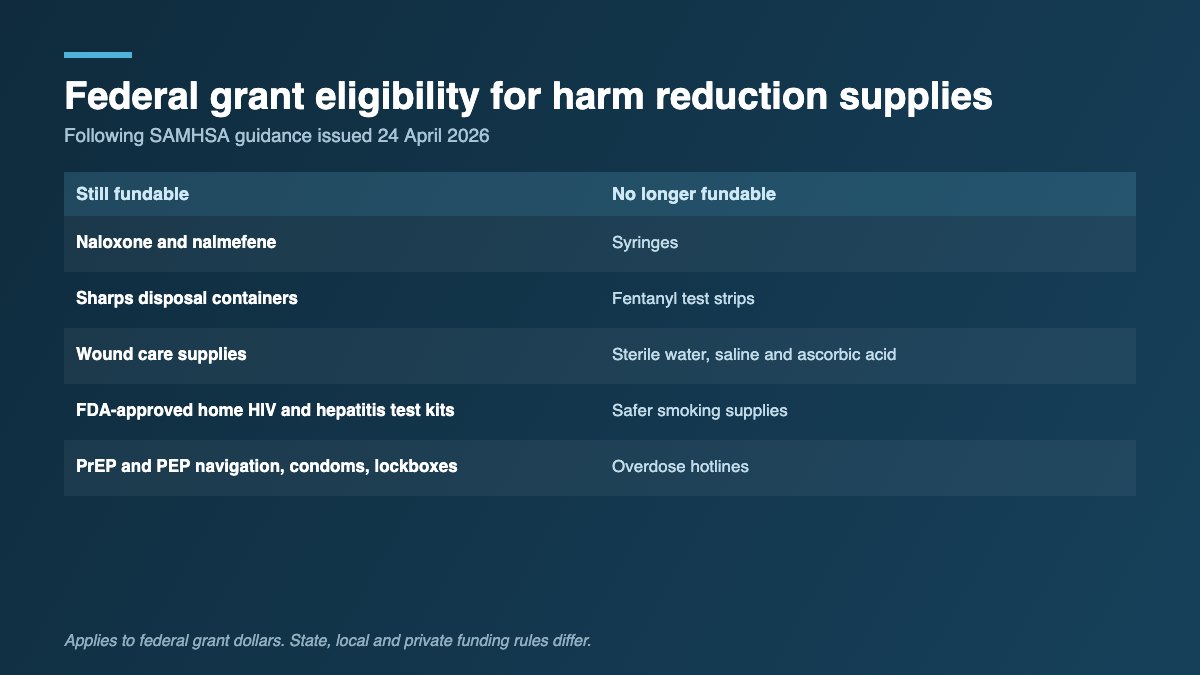
In April 2026 SAMHSA issued updated guidance extending the exclusion. Federal grant funds may no longer be used for syringes, fentanyl test strips, sterile water, saline, ascorbic acid, safer smoking supplies, or overdose hotlines. The guidance built on direction issued in July 2025 under an executive order.
Several items remain eligible: naloxone and nalmefene, lockboxes, sharps disposal containers, wound care supplies, FDA-approved home test kits for HIV and hepatitis, navigation for HIV prevention medication, and condoms.
The fentanyl test strip change is the most consequential single line, because CDC and SAMHSA had specifically permitted federal funds to be used for test strips beginning in 2021 and had described drug checking as an evidence-based strategy. Programs that built test strip distribution on federal grants now need another funding source for it.
The wider funding picture
This sits in a period of unusual volatility. In January 2026 an attempt to terminate nearly two billion dollars in SAMHSA discretionary grants was reversed within 24 hours following congressional pushback.
For anyone tracking this, the practical implication is that federal grant conditions are now a live variable in local service availability rather than a fixed background. A program’s supply list can change without any change in state law or local approval.
What to take from this
- CDC attributes roughly a 50 percent reduction in HIV and hepatitis C incidence to syringe services program use, rising above two thirds when combined with medication treatment.
- Participants are about five times more likely to enter treatment, which makes these programs a referral pathway rather than a substitute for care.
- Research has not found increases in crime or unsafe disposal associated with program presence.
- More than 550 programs operate across 45 states, DC and Puerto Rico. Five states have none.
- Federal funds have never covered syringes. Since April 2026 they also no longer cover fentanyl test strips, sterile water, safer smoking supplies or overdose hotlines.
- Naloxone, sharps disposal, wound care and home test kits remain federally fundable.
For background on the substances involved, see our drug information library and the pages on heroin and fentanyl.
Sources
This article relies on CDC material on syringe services programs, a March 2025 legal survey of state authorizing laws and program counts by the Legislative Analysis and Public Policy Association, SAMHSA grant guidance issued in April 2026, and contemporaneous reporting on federal harm reduction funding.
Why the local fight rarely turns on the evidence
Anyone who has sat through a county commission hearing on a syringe program will recognize the gap between the research summarized above and the argument in the room. Opposition is usually organized around two claims: that a program will attract drug use to the area, and that it will leave syringes in parks and gutters. Both have been studied, and neither is supported.
What tends to persuade skeptical officials is not the epidemiology but the fiscal case and the referral function. A single hepatitis C treatment course costs far more than a year of supplies for one participant, and the treatment referral figures give programs a defensible answer to the objection that they enable use rather than interrupt it.
The registration requirement in seven states is worth flagging separately. Requiring participants to give their names and be entered in a record deters exactly the people at highest risk, which is the opposite of what the program design assumes, and it is a policy choice made at state level rather than a federal condition.
Need help now? In an emergency call 911. If you are in crisis or thinking about suicide, call or text 988 (Suicide and Crisis Lifeline; veterans press 1). For free, confidential treatment referrals 24 hours a day, call the SAMHSA National Helpline at 1-800-662-4357. You can also search licensed programs at FindTreatment.gov, or use our rehab directory and state listings.
Addiction Now publishes health journalism and reference material. This page is not medical advice, a diagnosis, or a treatment plan. Do not stop a prescribed medication without talking to a clinician. Withdrawal from alcohol, benzodiazepines and barbiturates can cause seizures and can be fatal without medical supervision.