

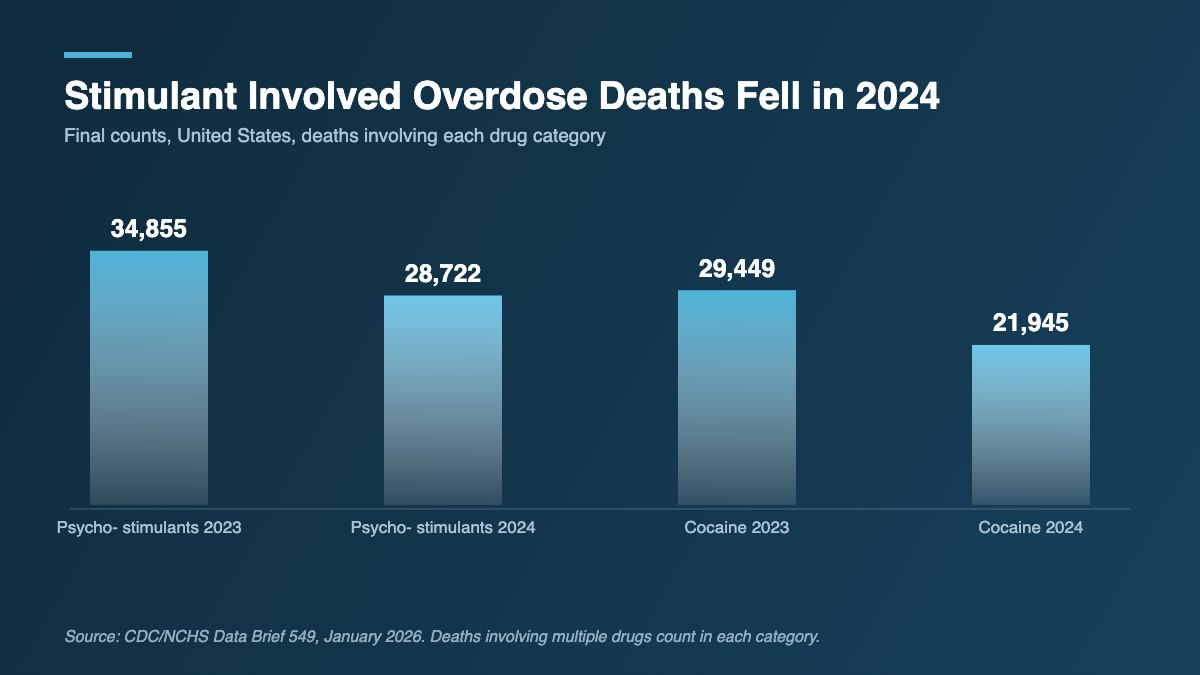
Deaths involving methamphetamine and related psychostimulants fell from 34,855 in 2023 to 28,722 in 2024. Cocaine involved deaths fell from 29,449 to 21,945. Both are large declines in final CDC data. Both are also easy to misread, because of how overdose deaths are counted.
The final 2024 numbers
The National Center for Health Statistics published final 2024 mortality figures in January 2026. Deaths involving psychostimulants with abuse potential, a category that covers methamphetamine, amphetamine and methylphenidate, dropped from a rate of 10.6 per 100,000 in 2023 to 8.5 in 2024, a statistically significant decline of 19.8 percent.
Cocaine involved deaths fell further in percentage terms, from 8.6 per 100,000 to 6.3, a 26.7 percent decline.
Both sat inside a much larger drop. Total drug overdose deaths went from 105,007 in 2023 to 79,384 in 2024, a 26.2 percent decline in the rate and the largest single year decline in the 2014 to 2024 period. Deaths involving synthetic opioids other than methadone, the category dominated by illicitly manufactured fentanyl, fell hardest of all, from 72,776 to 47,735.

Why the categories overlap
This is the part that trips up almost every summary of stimulant mortality. CDC counts a death in every drug category that appears on the death certificate. A death involving both fentanyl and cocaine is counted in the synthetic opioid category and in the cocaine category. It is one death appearing in two lines.
That means you cannot add the categories together and get a total, and it means the stimulant numbers are not describing a population of people who used only stimulants. A large share of what gets recorded as a cocaine or methamphetamine death also involves an opioid.
It also means the stimulant declines and the fentanyl decline are not independent findings. When the opioid in the supply becomes less lethal or less prevalent, deaths that would have been counted in both categories fall in both categories.
One more counting detail worth knowing: 96 percent of overdose deaths named at least one specific drug in both 2023 and 2024. The remaining share is recorded without a named substance, which puts a small floor of uncertainty under every category.
Do not mix final data with provisional data
There are two legitimate versions of 2024 in circulation and they are not interchangeable. The final count is 79,384. The provisional estimate for the same year was 81,313. Provisional figures are predicted counts that get revised as death records arrive, and they are tabulated by jurisdiction of occurrence rather than residence.
In May 2026, CDC published provisional 2025 estimates: about 69,973 overdose deaths, down almost 14 percent from the provisional 2024 figure, and a third consecutive annual decrease. Opioid involved deaths in that provisional series fell from roughly 55,296 to 44,564.
CDC stated that cocaine and psychostimulant deaths decreased as well in 2025, but did not publish specific counts for those two categories in that release. Anyone quoting a 2025 cocaine or methamphetamine number should be asked where it came from.
The decline is not uniform across states
In the provisional 2025 data, almost every state declined, but the spread was wide. Rhode Island, New York, North Carolina, Alabama and Vermont fell by 25 percent or more. New Mexico, Arizona and Colorado rose by 10 percent or more.
A national decline of 14 percent describes the country and not any particular place in it.
What this does and does not tell us
- Stimulant involved deaths fell substantially in 2024, in final data, and CDC says they fell again in 2025 provisional data.
- Tens of thousands of stimulant involved deaths still occurred: 28,722 psychostimulant and 21,945 cocaine in 2024 alone.
- Categories overlap, so the numbers cannot be summed and do not describe stimulant only use.
- Label every figure final or provisional. The two 2024 numbers differ by about 1,900 deaths.
- There is no FDA approved medication for stimulant use disorder, unlike opioid use disorder, so a falling death count does not imply expanding treatment options.
- State level direction varies enough that a national figure should not be used to describe a local situation.
Our reference pages on methamphetamine, cocaine and prescription stimulants cover the substances behind these categories in more detail.
Sources
Final 2023 and 2024 mortality figures come from the Centers for Disease Control and Prevention and the National Center for Health Statistics, Data Brief 549, published January 2026, drawing on the National Vital Statistics System. Provisional 2025 estimates and state level comparisons come from a CDC and NCHS press release published in May 2026. The multiple drug counting convention and the 96 percent drug specificity figure are stated by NCHS in Data Brief 549. The absence of an approved medication for stimulant use disorder is stated by the National Institute on Drug Abuse and by the Food and Drug Administration, which has issued draft guidance to support development of such treatments.
Need help now? In an emergency call 911. If you are in crisis or thinking about suicide, call or text 988 (Suicide and Crisis Lifeline; veterans press 1). For free, confidential treatment referrals 24 hours a day, call the SAMHSA National Helpline at 1-800-662-4357. You can also search licensed programs at FindTreatment.gov, or use our rehab directory and state listings.
Addiction Now publishes health journalism and reference material. This page is not medical advice, a diagnosis, or a treatment plan. Do not stop a prescribed medication without talking to a clinician. Withdrawal from alcohol, benzodiazepines and barbiturates can cause seizures and can be fatal without medical supervision.