
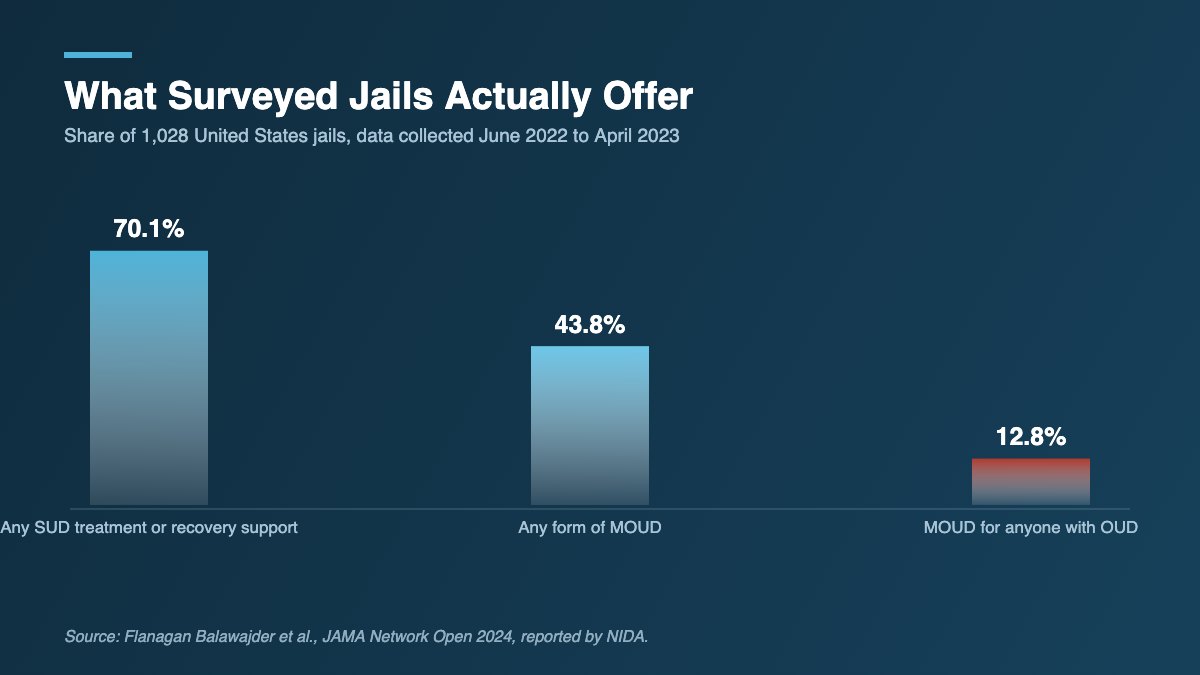
In a survey of 1,028 jails across the United States, 43.8 percent offered any form of medication for opioid use disorder. Only 12.8 percent made it available to anyone in the facility who had the disorder. The gap between those two numbers is where most of the policy fight now sits.
What the national survey found
The survey, published in JAMA Network Open and reported by the National Institute on Drug Abuse, collected data between June 2022 and April 2023. It remains the largest look at the question.
Among jails that did offer medication, buprenorphine was most common at 69.9 percent, followed by naltrexone at 54.5 percent and methadone at 46.6 percent. Just over 70 percent of jails offered some form of substance use treatment or recovery support, which is a much broader category than medication and should not be read as the same thing.
The most frequently cited reason for not offering medication was not cost or ideology. It was staffing: 49.8 percent of jails pointed to a lack of adequately licensed personnel.
Offering a medication is not the same as providing it
A follow up survey, conducted between February and July 2023 and also published in JAMA Network Open, looked at which people inside a facility actually get access. It found that 27.6 percent of jails offer all three approved medications to at least some individuals, while 16.9 percent offer all three to anyone with opioid use disorder.
The eligibility pattern is consistent and revealing. Jails were most likely to continue medication for people who arrived already taking it, at 79.7 percent, and for pregnant people already on medication, at 70.9 percent. Far fewer extended it to anyone with the disorder, at 43.7 percent. Fewest of all, 20 percent, offered it to people approaching release.
That last figure matters more than any other number here. The weeks after release are when tolerance has dropped and overdose risk is at its highest, which makes it the moment when medication and naloxone do the most good.
Barriers cited in the follow up survey were again largely operational: policies and procedures were named as a top challenge for buprenorphine by 78.7 percent of facilities and methadone by 73.5 percent, while 60.7 percent said they needed more medical staff and 57 percent wanted education on evidence based treatment.
The federal legal pressure is coming through the ADA
The Department of Justice takes the position that the Americans with Disabilities Act protects people in recovery from opioid use disorder, including people taking medication for it at a provider’s direction, and prohibits state and local governments from discriminating against them.
In November 2023, the Department of Justice announced an agreement with Allegheny County, Pennsylvania. The county agreed to offer any medically appropriate approved medication for opioid use disorder to everyone booked into the Allegheny County Jail, and to pay 10,000 dollars to a person allegedly denied methadone in violation of the ADA. The three year agreement requires medical evaluation at intake, continuation of existing prescriptions, and bars the use of incentives or punishments to steer a person toward one medication over another.
That last provision is unusual and worth noting, because it addresses a practice that does not show up in survey percentages.
State law is uneven
Some states have legislated. New York enacted a law in October 2021 establishing a medication assisted treatment program for incarcerated people along with treatment and transition services in jails.
Massachusetts is often described as having a statewide mandate, and the statute is narrower than that. Massachusetts law requires the Commissioner of Correction to offer medication for opioid use disorder at four named facilities, and states explicitly that the program is not required at any other state correctional facility. It does also bar incentives, rewards or punishments intended to influence a prisoner’s decision about medication.
We are not aware of an authoritative current tally of how many states legally mandate medication in corrections. Individual state laws are verifiable; a national count is not.
Takeaways
- Fewer than half of surveyed jails offer any medication for opioid use disorder, and about one in eight offer it to anyone who has the disorder.
- Access is usually limited to people already on medication at intake, or to pregnant people already on it.
- Only about one in five facilities offering medication extend it to people near release, the period of highest overdose risk.
- Staffing and internal policy, not cost, are the barriers facilities name most often.
- Enforcement is arriving through the Americans with Disabilities Act rather than through a single federal treatment mandate.
- In one study of 185 jails, only 30 percent provided naloxone at discharge.
For background on the medications and substances involved, see our pages on drug information, heroin and oxycodone.
Sources
Survey findings come from Flanagan Balawajder and colleagues in JAMA Network Open, 2024 and 2025, reported by the National Institute on Drug Abuse and by the Justice Community Opioid Innovation Network. The Allegheny County agreement and the ADA position come from the United States Department of Justice, Civil Rights Division. State statutes come from the New York State Senate and the Massachusetts General Court. The naloxone at discharge figure comes from a Pew Charitable Trusts issue brief published in September 2025.
Need help now? In an emergency call 911. If you are in crisis or thinking about suicide, call or text 988 (Suicide and Crisis Lifeline; veterans press 1). For free, confidential treatment referrals 24 hours a day, call the SAMHSA National Helpline at 1-800-662-4357. You can also search licensed programs at FindTreatment.gov, or use our rehab directory and state listings.
Addiction Now publishes health journalism and reference material. This page is not medical advice, a diagnosis, or a treatment plan. Do not stop a prescribed medication without talking to a clinician. Withdrawal from alcohol, benzodiazepines and barbiturates can cause seizures and can be fatal without medical supervision.