


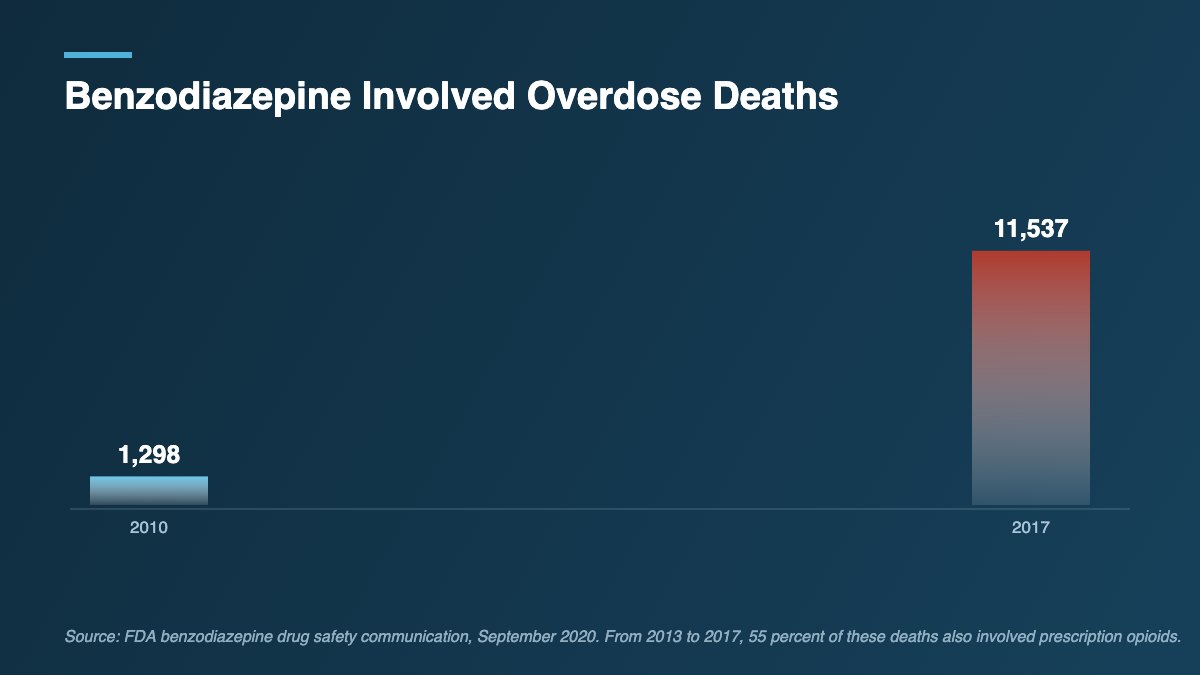
Benzodiazepine involved overdose deaths rose from 1,298 in 2010 to 11,537 in 2017. Fewer than 3 percent of those deaths involved benzodiazepines alone. Between 2013 and 2017, 55 percent of them also involved prescription opioids. This is the combination the FDA singled out for its strongest available warning.
Why the two together are worse than either alone
The mechanism is additive suppression of breathing through two different routes. Opioids depress respiratory drive by acting on mu opioid receptors in the brainstem. Benzodiazepines slow brain activity by binding to gamma-aminobutyric acid receptors, the brain’s main inhibitory system.
Neither is inherently a respiratory poison at therapeutic doses in a tolerant person. Together they remove both the drive to breathe and the arousal response that would normally wake someone who was under-breathing. That is why the combination kills at doses either drug alone would survive.
What the boxed warning says
In August 2016 the FDA announced it was adding boxed warnings, its strongest warnings, to prescription opioid pain medicines, prescription opioid cough medicines and benzodiazepines. The current labeling language on opioid products reads:

Concomitant use of opioids with benzodiazepines or other central nervous system depressants, including alcohol, may result in profound sedation, respiratory depression, coma and death. It then directs prescribers to reserve concomitant prescribing for patients for whom alternative treatment options are inadequate, to limit dosages and durations to the minimum required, and to follow patients for signs and symptoms of respiratory depression and sedation.
The 2016 announcement also told prescribers to avoid prescribing opioid cough medicines for patients taking benzodiazepines or other central nervous system depressants including alcohol.
The warning signs to act on
The FDA listed specific red flags for patients and families: unusual dizziness or lightheadedness, extreme sleepiness, slowed or difficult breathing, or unresponsiveness.
Extreme sleepiness is the one that gets rationalized. Someone who is difficult to rouse after taking both is not simply tired, and waiting to see whether they wake up is the wrong call. Slowed or difficult breathing in that situation is an emergency.
Poison center data illustrates how rarely this involves one substance. Among 8,761 calls involving benzodiazepine misuse or abuse in 2017, 63 percent involved multiple substances, most commonly prescription opioids, alcohol or stimulants, and medical outcomes in those cases were more severe than in cases involving benzodiazepines alone.
An important qualification about treatment
There is a version of this warning that does harm, and the FDA addressed it directly. In its 2020 benzodiazepine safety communication the agency cautioned against withholding medications for opioid use disorder from patients who are taking benzodiazepines.
The guidance is to take precautions when benzodiazepines are used in combination with opioid addiction medications, and that careful medication management by health care professionals can reduce the increased risk of serious side effects. In other words, a patient on a prescribed benzodiazepine should not be refused buprenorphine or methadone on that basis alone. Untreated opioid use disorder carries its own mortality, and the balance of risk generally favors treating it.
That distinction matters because patients do get turned away, and the agency’s own position does not support doing so.
The other combinations that work the same way
Alcohol belongs in this discussion because it acts on the same inhibitory system as benzodiazepines. The FDA states plainly not to drink alcohol with benzodiazepines, because alcohol can increase the risk of serious and life threatening side effects.
National Institute on Alcohol Abuse and Alcoholism guidance on mixing alcohol with medicines lists, for lorazepam, clonazepam, chlordiazepoxide, diazepam and alprazolam: drowsiness, dizziness, increased risk for overdose, slowed or difficult breathing, impaired motor control, unusual behavior and memory problems. The same list appears for opioid combination products including oxycodone, hydrocodone, meperidine and codeine preparations.
So alcohol plus benzodiazepines, alcohol plus opioids, and opioids plus benzodiazepines are three versions of one problem. Adding any two of the three multiplies risk in the same way.
See our pages on benzodiazepines, oxycodone and alcohol, and the wider drug information library.
Takeaways
- Benzodiazepine involved overdose deaths rose from 1,298 in 2010 to 11,537 in 2017.
- Fewer than 3 percent involved benzodiazepines alone, and 55 percent also involved prescription opioids.
- Both drug classes carry a boxed warning about the combination, added in 2016.
- Red flags are unusual dizziness, extreme sleepiness, slowed or difficult breathing and unresponsiveness.
- Alcohol behaves like a benzodiazepine here, so alcohol plus opioids carries the same additive risk.
- A prescribed benzodiazepine is not a reason to be denied buprenorphine or methadone. The FDA advises careful management rather than withholding treatment.
Sources
Food and Drug Administration drug safety communication on combining opioid medicines with benzodiazepines, August 2016, and drug safety communication requiring an updated boxed warning for the benzodiazepine class, September 2020. FDA approved labeling for oxycodone hydrochloride tablets, boxed warning section, via DailyMed at the National Library of Medicine. National Institute on Alcohol Abuse and Alcoholism, Harmful Interactions: Mixing Alcohol With Medicines, NIH publication 13-5329, revised 2014.
Need help now? In an emergency call 911. If you are in crisis or thinking about suicide, call or text 988 (Suicide and Crisis Lifeline; veterans press 1). For free, confidential treatment referrals 24 hours a day, call the SAMHSA National Helpline at 1-800-662-4357. You can also search licensed programs at FindTreatment.gov, or use our rehab directory and state listings.
Addiction Now publishes health journalism and reference material. This page is not medical advice, a diagnosis, or a treatment plan. Do not stop a prescribed medication without talking to a clinician. Withdrawal from alcohol, benzodiazepines and barbiturates can cause seizures and can be fatal without medical supervision.