

Xylazine is a veterinary sedative that has spread widely through the illicit opioid supply, and it creates two specific problems. Naloxone does not reverse it, because it is not an opioid. And repeated injection is associated with severe necrotic skin ulcers that can appear on parts of the body nowhere near an injection site.
What it is and what it does
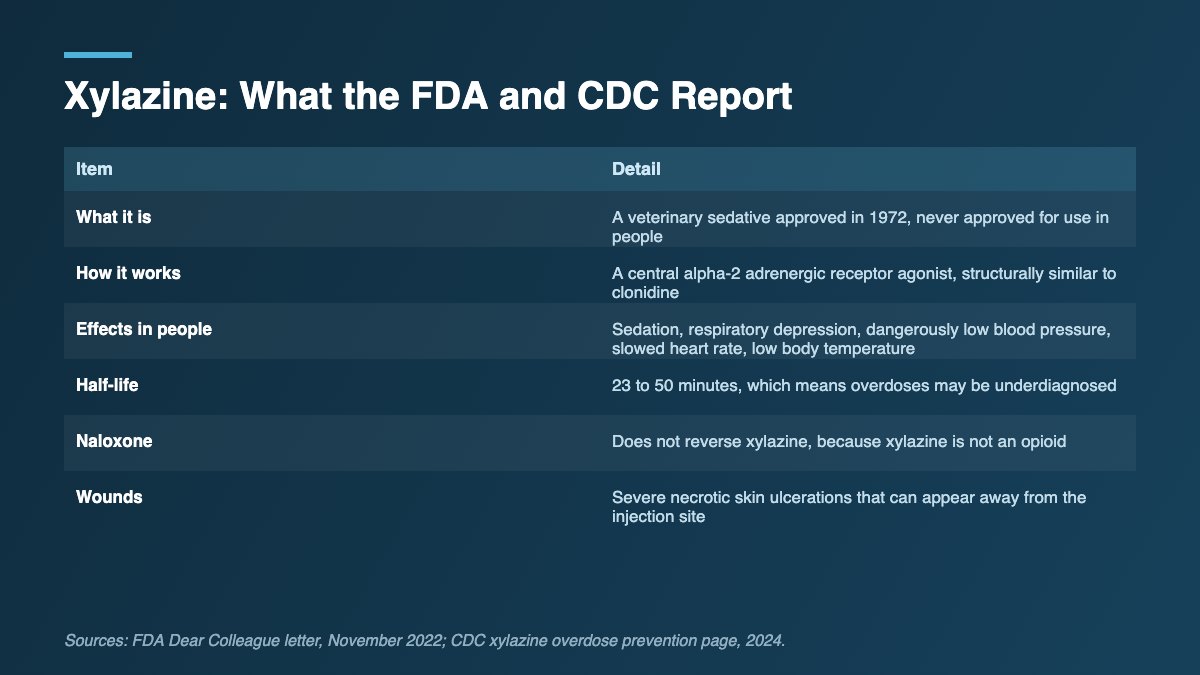
The Food and Drug Administration describes xylazine as a non-opioid agent originally approved in 1972 as a sedative and analgesic for veterinary medicine. It has never been approved for use in humans and is not a federally controlled substance, though it is not approved for people either.
Structurally it resembles levamisole, clonidine and tizanidine. Like clonidine, it acts as a central alpha-2 adrenergic receptor agonist in the brainstem, causing a rapid decrease in the release of norepinephrine and dopamine in the central nervous system.
In people, the CDC lists sedation, difficulty breathing, dangerously low blood pressure, slowed heart rate, wounds that can become infected, severe withdrawal symptoms and death. The FDA adds low body temperature, constricted pupils and high blood glucose to the acute toxicity picture, and notes the problem this creates clinically: the presentation can look like opioid toxicity, making it hard to tell the two apart at the bedside.
It usually arrives by injection alongside heroin or fentanyl, and has also been found combined with methamphetamine and cocaine. Reported street names include tranq and tranq dope.
Why naloxone does not work, and why to use it anyway
The FDA states directly that naloxone is not known to be effective in reversing overdoses involving xylazine, because xylazine is not an opioid. Clinicians managing overdoses are advised to consider xylazine exposure when a patient does not respond as expected to naloxone.
The CDC gives the practical instruction that follows: naloxone will not reverse the effects of xylazine, but because xylazine is so often used with opioids like fentanyl, naloxone should still be given. The opioid component is what stops breathing, and naloxone addresses that. The CDC emphasizes rescue breaths, calling 911 and using the recovery position alongside it.
One warning is worth repeating plainly. The FDA states that reversal agents used in veterinary medicine, such as yohimbine hydrochloride and tolazoline hydrochloride, are not known to be safe and effective in humans and should not be used. Appropriate supportive care is the answer for patients who do not respond to naloxone.
The detection problem
Xylazine has a half-life of 23 to 50 minutes. The FDA notes that this rapid elimination means overdoses may be underdiagnosed even when appropriate testing is performed, because by the time a sample is taken the drug may have cleared.
Compounding that, xylazine is not readily identified by routine immunoassay toxicology screens and therefore may be under-detected. Additional analytical techniques are required. So the true prevalence in overdose deaths is likely higher than surveillance captures.
The wounds
This is the feature clinicians report as distinctive. The FDA states that repeated exposure to xylazine by injection has been associated with severe necrotic skin ulcerations that are distinctly different from the cellulitis and abscesses usually associated with injection drug use, and that these ulcerations may develop in areas of the body away from the injection site.
The CDC adds that skin wounds may become infected and worsen quickly, that when treated early they can be managed with basic wound care, and that left untreated they can lead to amputation or become life threatening. Early wound care matters more here than in most contexts.
Withdrawal, and why standard medications do not cover it
The FDA reports that repeated exposure may result in dependence and withdrawal, with symptoms such as agitation or severe anxiety when usual doses are reduced or stopped.
The clinically important part is that withdrawal from xylazine is not managed by standard pharmacological treatment for opioid use disorder, meaning methadone, buprenorphine or naltrexone. No medication currently carries an approved indication for managing xylazine withdrawal.
The agency also notes what this means for inpatient care: clinicians must be prepared to manage xylazine withdrawal at the same time as treating the wounds, since both frequently present together.
How widespread it is
CDC surveillance across 20 states and the District of Columbia found the monthly percentage of deaths involving illicitly made fentanyl with xylazine detected rose from 3 percent in January 2019 to 11 percent in June 2022. A separate ten city study found xylazine involved in less than 1 percent of overdose deaths in 2015 and nearly 7 percent in 2020.
On the supply side, DEA laboratory data indicated roughly 23 percent of fentanyl powder and 7 percent of fentanyl pills seized in 2022 contained xylazine, and the agency has seized xylazine and fentanyl mixtures in 48 of 50 states. In eight Maryland syringe services programs during 2021 and 2022, xylazine was found in almost 80 percent of drug samples containing opioids. In Philadelphia it appeared in 31 percent of overdose deaths involving heroin or fentanyl in 2019.
See our fentanyl page, heroin page and drug information library for related material.
Takeaways
- Xylazine is a veterinary sedative, not an opioid, and naloxone does not reverse it.
- Give naloxone anyway. Xylazine is almost always present alongside fentanyl, and the opioid is what stops breathing.
- Never use veterinary reversal agents in a person. Supportive care and 911 are the correct response.
- Its 23 to 50 minute half-life and invisibility to routine screens mean it is likely undercounted.
- Wounds can appear far from injection sites and worsen fast. Early wound care can prevent amputation.
- Buprenorphine, methadone and naltrexone do not treat xylazine withdrawal, and no approved medication currently does.
Sources
Food and Drug Administration, Dear Colleague letter warning about the risk of xylazine exposure in humans, November 2022, and the accompanying alert to health care professionals. Centers for Disease Control and Prevention, xylazine overdose prevention page, 2024. Kariisa M and colleagues, Morbidity and Mortality Weekly Report, 2023. Friedman J and colleagues, Drug and Alcohol Dependence, 2022. Russell E and colleagues, Morbidity and Mortality Weekly Report, 2023. Drug Enforcement Administration laboratory seizure data.
Need help now? In an emergency call 911. If you are in crisis or thinking about suicide, call or text 988 (Suicide and Crisis Lifeline; veterans press 1). For free, confidential treatment referrals 24 hours a day, call the SAMHSA National Helpline at 1-800-662-4357. You can also search licensed programs at FindTreatment.gov, or use our rehab directory and state listings.
Addiction Now publishes health journalism and reference material. This page is not medical advice, a diagnosis, or a treatment plan. Do not stop a prescribed medication without talking to a clinician. Withdrawal from alcohol, benzodiazepines and barbiturates can cause seizures and can be fatal without medical supervision.