


Most US states have a legal route to place someone in substance use treatment against their will. A dataset published on LawAtlas by researchers at Northeastern University and Temple University counted that authority in more than 37 states and the District of Columbia. What the statutes rarely specify is which treatment must follow, or who tracks what happens after release.
What the term actually covers
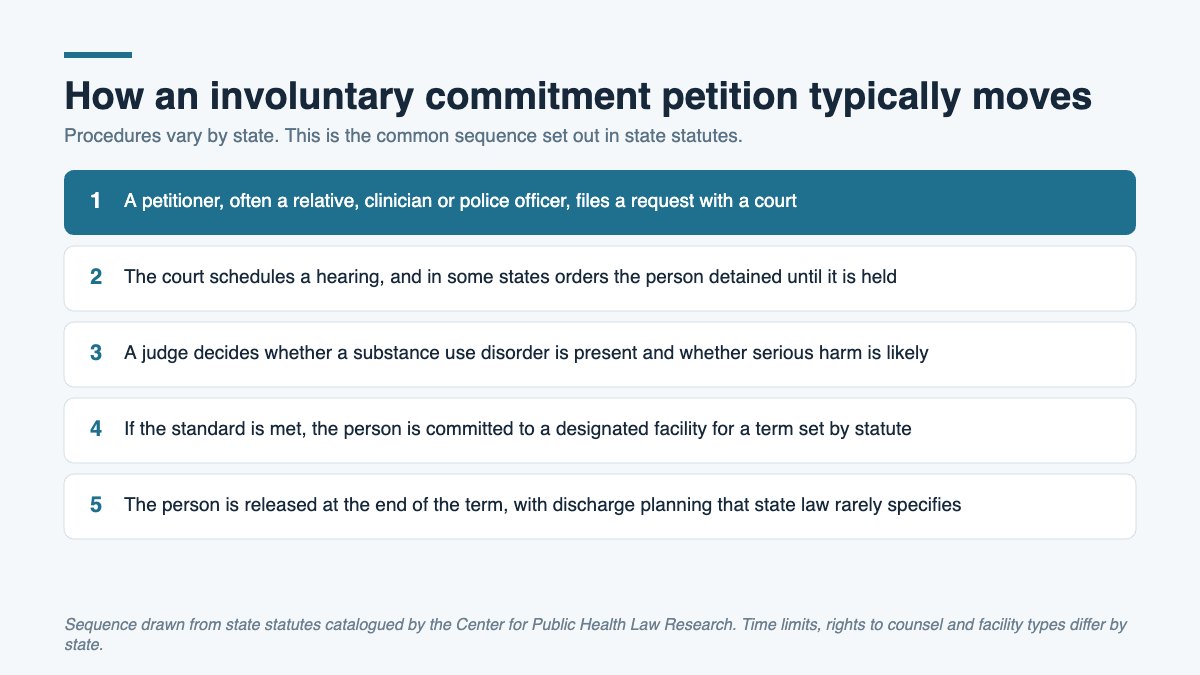
Involuntary commitment, also called civil commitment, is a court process rather than a criminal one. A petitioner asks a judge to find two things: that a person has a substance use disorder, and that the disorder makes serious harm likely. If the judge agrees, the person can be held in a designated facility for a period fixed by statute, without ever being charged with a crime.
Almost everything else varies. Who may petition, what standard of proof applies, whether the person is entitled to a lawyer, how long a hold may last, and whether the placement is a hospital, a licensed treatment facility or a corrections facility are all set state by state. In Massachusetts, the best documented example, a commitment under Section 35 of Chapter 123 can run up to 90 days.
How many states have the authority
The clearest legal map comes from a policy surveillance dataset built by the Health in Justice Action Lab at Northeastern University School of Law and published by the Center for Public Health Law Research at Temple University on LawAtlas. In its snapshot as of March 2018, substance use disorder was grounds for involuntary commitment in more than 37 states and the District of Columbia.
That total splits two ways. Twenty nine states had passed legislation specifically authorizing involuntary commitment for substance use. In nine more, the general mental health commitment statute was written broadly enough to reach substance use, or defined chemical dependence as an element of mental illness, so no separate law was needed.
The same dataset recorded an acceleration. In the four years before the 2018 snapshot, states passed 25 new or amended commitment provisions, against an average of roughly two in comparable periods across the previous two decades. Legislatures have continued to amend these statutes since, so any count is a snapshot rather than a permanent figure. Anyone dealing with a specific case should read the current text of their own state law.
Massachusetts is the one state with published outcome data
Massachusetts uses the mechanism heavily and, unusually, now reports on it. In 2022 the legislature added a provision known as Section 138, requiring the Massachusetts Department of Public Health to publish an annual evaluation of Section 35 commitments alongside broader overdose data. The department published the first of those reports in October 2024.
The analysis compared people who received voluntary treatment with people who were committed involuntarily between 2015 and 2021. The Action Lab at Northeastern, which worked on the reporting requirement and has since summarized the findings, describes the report as identifying a 1.4 fold higher risk of non fatal overdose following involuntary commitment, and a possible increase in all cause mortality, after adjustment for other factors.
That is one state, one period, and an observational comparison rather than a randomized one. People routed into commitment are not identical to people who walk into treatment voluntarily, and no statistical adjustment fully closes that gap. It is still the most direct outcome evidence any state has put on the public record.
Why the risk direction is biologically plausible
There is a mechanism that would explain a finding of this shape. Any sustained period of enforced abstinence lowers opioid tolerance. If someone resumes use at a dose that was previously routine, the margin between a familiar amount and a fatal one narrows sharply. This is the same mechanism behind the well documented rise in overdose deaths in the weeks after release from jail or prison, and it is why what happens at discharge matters more than the length of the hold.
Two things reduce that risk at the point of release: continuity of medication for opioid use disorder, and naloxone in the person’s hands before they leave. Commitment statutes are largely silent on both. They describe who may petition and how long a facility may hold someone; they far less often require that the facility offer medication, or that anyone follow up afterwards. Our reference pages on fentanyl and heroin cover the tolerance question in more detail.
The data that does not exist
Between late 2020 and mid 2021 the Action Lab filed public records requests in 15 states with the broadest commitment laws, seeking data covering 2015 to 2020. Only five states returned full or partial records: Massachusetts, Minnesota, North Carolina, South Carolina and Florida. Each of those five could report a total number of people committed and a breakdown by race and gender. None could provide overdose totals during or after commitment. Some states reported that they do not collect commitment data at all.
This is the practical problem for anyone trying to evaluate the policy. A mechanism that removes a person’s liberty on health grounds operates at scale across most of the country, and in most states no public dataset exists that would show whether the health outcome improved. That gap is not evidence against commitment; it is the absence of evidence in either direction.
Takeaways
- Substance use disorder was grounds for involuntary commitment in more than 37 states and the District of Columbia as of the March 2018 LawAtlas snapshot, split between dedicated statutes and broadly written mental health laws.
- Statutes concentrate on procedure. They set out who may petition and how long a hold lasts, and much less often specify what treatment must be offered.
- Massachusetts is the state with the most developed public reporting, following a 2022 law requiring an annual evaluation.
- Loss of tolerance during enforced abstinence is a well established overdose risk, which makes discharge planning, medication continuity and naloxone at release the decisive variables.
- Most states cannot answer basic questions about their own commitment systems, including how many people are committed and what happens to them afterwards.
- Because legislatures amend these laws frequently, check the current statute in your state rather than a published count from a given year. Our drug information library covers the substances most often named in these petitions.
Sources
This article draws on the Center for Public Health Law Research at Temple University, which publishes the LawAtlas policy surveillance dataset on laws authorizing involuntary commitment for substance use; the Health in Justice Action Lab at Northeastern University School of Law, which built that dataset and ran the multi state public records project; the Massachusetts Department of Public Health, which publishes the Section 35 evaluation required by the 2022 reporting law; the Massachusetts General Laws, Chapter 123, Section 35; and peer reviewed work on compulsory abstinence programs published in the International Journal of Drug Policy and on the expansion of involuntary commitment published in Health and Human Rights.
Need help now? In an emergency call 911. If you are in crisis or thinking about suicide, call or text 988 (Suicide and Crisis Lifeline; veterans press 1). For free, confidential treatment referrals 24 hours a day, call the SAMHSA National Helpline at 1-800-662-4357. You can also search licensed programs at FindTreatment.gov, or use our rehab directory and state listings.
Addiction Now publishes health journalism and reference material. This page is not medical advice, a diagnosis, or a treatment plan. Do not stop a prescribed medication without talking to a clinician. Withdrawal from alcohol, benzodiazepines and barbiturates can cause seizures and can be fatal without medical supervision.