


The 988 Suicide and Crisis Lifeline has handled 23.3 million contacts since it launched in July 2022. Demand has roughly doubled. The financing underneath it has not kept pace: only about a dozen states have enacted a dedicated funding stream, and most call centers report they cannot hire the staff they need.
What the volume looks like
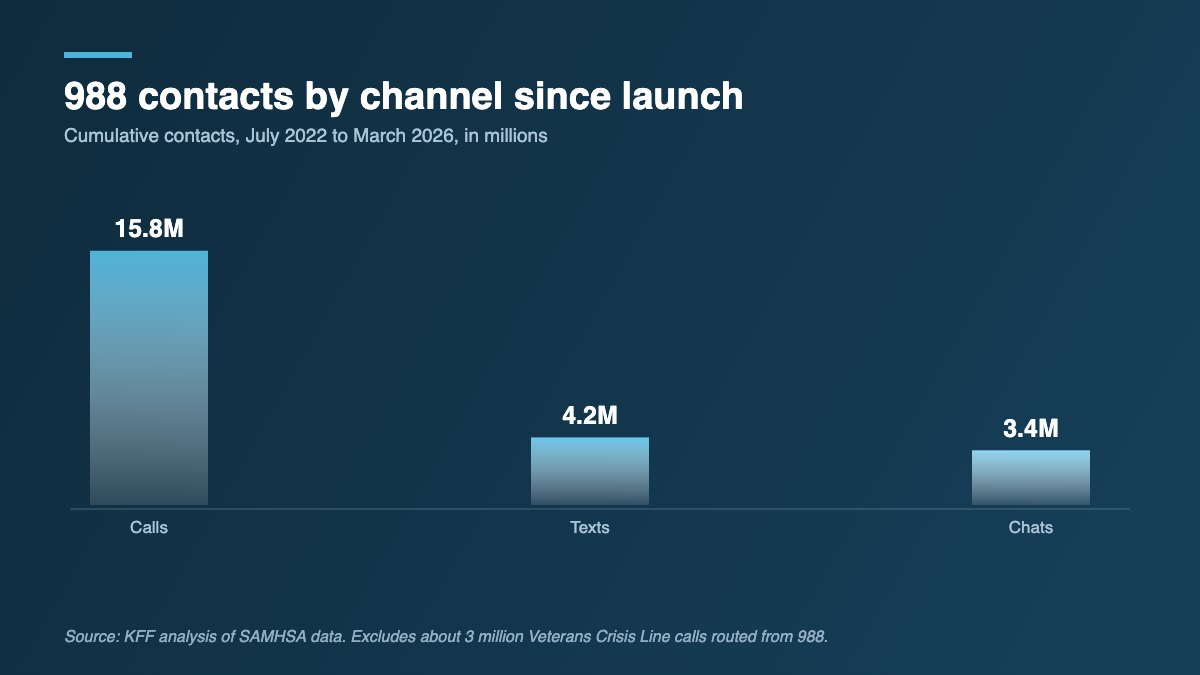
Between the July 2022 launch and March 2026, 988 received 15.8 million calls, 4.2 million texts and 3.4 million chats, for 23.3 million contacts in total. A further 3 million calls were routed on to the Veterans Crisis Line and are counted separately.
The trend line is steady growth rather than a launch spike. Monthly contacts have consistently exceeded 600,000 over the past year and have approached or passed 700,000 since late 2025. The comparison point is June 2022, the month before the three-digit number went live, when the predecessor Lifeline handled 277,407 contacts. Volume in the twelve months to March 2026 was 15 percent higher than the year before, and nearly 50 percent higher than two years before.
The number that measures whether it works
Contact volume is an input. The operational measure that matters is whether a call is answered by a center in the caller’s own state, because local centers are the ones that can connect someone to services that actually exist near them. Calls that go unanswered locally are rerouted to national backup centers.

By May 2026, 26 states were answering at least 90 percent of their 988 calls in state, up from 8 states before launch. That is real progress. The spread behind the average is wide: in-state answer rates ranged from 62 percent in the District of Columbia to 99 percent in Mississippi and Rhode Island.
A structural constraint sits behind those numbers. As of 2024, fewer than half of the country’s crisis hotline call centers, roughly 200 of 573, participated in the 988 network at all.
Where the money comes from, and does not
The federal government funded the launch and continues to support central functions. SAMHSA announced a 231 million dollar funding opportunity in January 2026 to administer the Lifeline.
Local call centers are a different matter. Congress built 988 on the 911 model, which anticipated states levying a small telecom fee per phone line to fund local capacity. Four years in, only 12 states have enacted such a fee, typically under 45 cents per line per month, and about five more have other recurring appropriations. Everywhere else, centers are financed year to year, which makes hiring and retention difficult in a way that is entirely predictable.
A 2025 SAMHSA survey of call center leaders, covering roughly 77 percent of centers nationally, found that around three quarters reported staffing shortages, and 89 percent reported difficulty obtaining the resources to hire.
The outcome evidence so far
A study published in JAMA and reported in July 2026 estimated that between July 2022 and December 2024, suicide deaths among people aged 15 to 34 were about 11 percent lower than would have been projected without 988, an estimated 4,372 fewer deaths. The effect was significantly larger in the ten states with the highest 988 uptake, which is the pattern you would expect if the line itself were responsible rather than some coincident trend.
The wider mortality picture is mixed and worth stating plainly. Suicide deaths declined modestly in 2024 and were roughly stable in provisional 2025 data. Non-firearm suicides have fallen every year since 2022, while firearm suicides have risen every year since 2019. Emergency department visits for suspected suicide attempts were about 7 percent lower in 2025 than in 2021.
In a SAMHSA survey of 437 adult callers, about 98 percent described contacting 988 as helpful and 88 percent said the contact stopped them from acting on suicidal thoughts. Self-reported survey data from people who chose to respond is weaker evidence than mortality modeling, and should be read that way.
The specialized youth service
From 2022, 988 operated a subnetwork for LGBTQ+ young people, reachable by pressing 3 on a call or texting PRIDE, delivered with The Trevor Project. It accounted for roughly 10 percent of all 988 contacts. It was funded at 29.7 million dollars in the fiscal 2023 omnibus, rising to 33 million in fiscal 2024.
SAMHSA announced its elimination in June 2025 and the service closed on 17 July 2025. Congress subsequently appropriated 33.1 million dollars for fiscal 2026 specifically to restore it, and members of both parties wrote to the department urging reinstatement during 2026. In a June 2026 letter, the department said it was assessing how to restore the service while ensuring compliance with Executive Order 14168, and indicated it aimed to do so by the end of the year. As of the most recent reporting available at the time of writing, the service had not been restored.
What to take from this
- 23.3 million contacts in the first three and a half years, growing about 15 percent year on year rather than tapering off.
- Calls still dominate, but text and chat together now account for well over a quarter of contacts.
- 26 states answer at least 90 percent of calls in state, up from 8 before launch. The range runs from 62 percent to 99 percent.
- Fewer than half of the nation’s crisis call centers are in the 988 network.
- Only 12 states have a dedicated 988 telecom fee. Most centers rely on year-to-year funding, and about three quarters report staffing shortages.
- The strongest outcome estimate to date attributes roughly 4,372 fewer deaths among people aged 15 to 34 to the line’s first two and a half years.
Crisis and substance use frequently occur together. For background, see our drug information library and the pages on alcohol and benzodiazepines.
Sources
This article relies on published analysis from KFF and The Pew Charitable Trusts, SAMHSA performance data and press announcements, a study published in JAMA on suicide mortality following the 988 launch, and contemporaneous reporting on the specialized youth service. Figures on state answer rates and funding mechanisms reflect the most recent published counts and change as states legislate.
Need help now? In an emergency call 911. If you are in crisis or thinking about suicide, call or text 988 (Suicide and Crisis Lifeline; veterans press 1). For free, confidential treatment referrals 24 hours a day, call the SAMHSA National Helpline at 1-800-662-4357. You can also search licensed programs at FindTreatment.gov, or use our rehab directory and state listings.
Addiction Now publishes health journalism and reference material. This page is not medical advice, a diagnosis, or a treatment plan. Do not stop a prescribed medication without talking to a clinician. Withdrawal from alcohol, benzodiazepines and barbiturates can cause seizures and can be fatal without medical supervision.