

Opioid manufacturers, distributors and pharmacies are paying more than 54 billion dollars to settle claims over their role in the overdose crisis, according to a running tally kept by KFF Health News. Most of that money is legally restricted to addiction remediation. What almost none of it carries is a federal requirement that any government publish what it actually spent.
The money is real, and the payment schedule is long
The settlements are not one agreement but many. KFF Health News, which has tracked the payouts since they began in 2022, puts the combined restitution at more than 54 billion dollars, with more than 50 billion of that flowing to state and local governments over roughly 18 years. The distributors pay across that full 18 year window. Payments from Janssen, the Johnson and Johnson subsidiary, are front loaded instead, with about 80 percent arriving in the first three years and the remainder spread over six more.
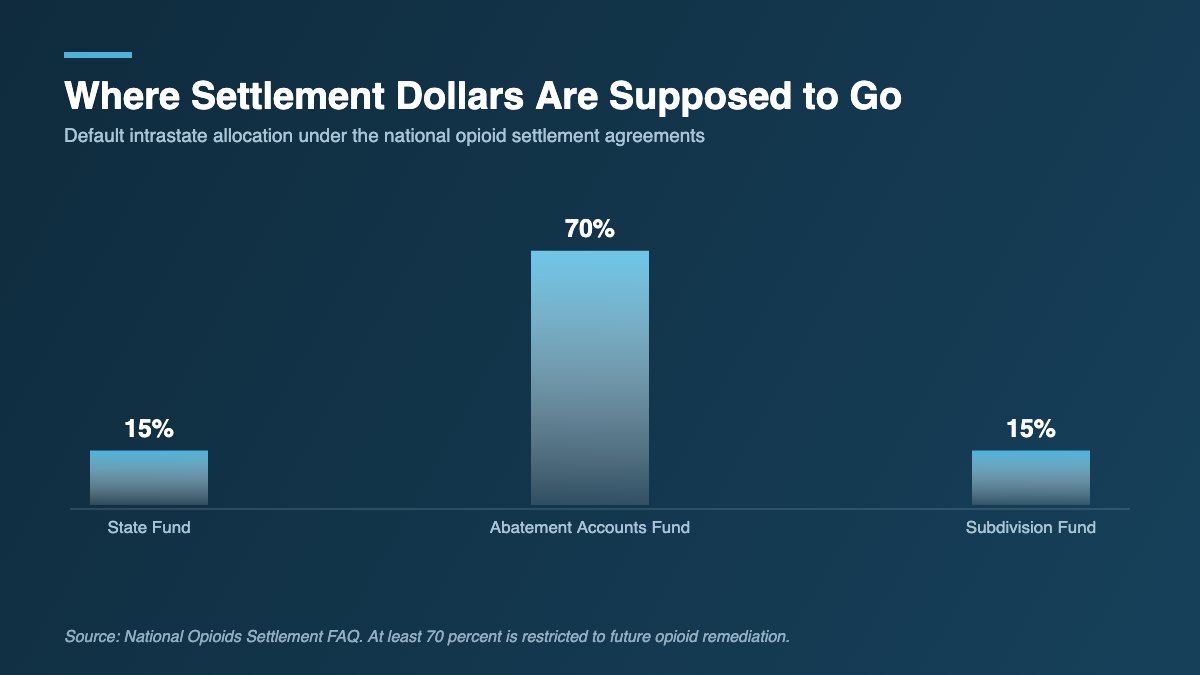
Restrictions are attached. Michigan and its Department of Health and Human Services, describing the terms of the two largest national settlements, note that 85 percent of the dollars must be spent on opioid remediation, and that 70 percent of payments are restricted specifically to future remediation rather than reimbursement for past costs. Those two figures get conflated constantly, and they are not the same thing.
The default split inside a state, under the national agreements, sends 15 percent to a state fund, 70 percent to abatement accounts, and 15 percent to a subdivision fund for cities and counties.

What happened to the first few years of payments
Researchers at the Johns Hopkins Bloomberg School of Public Health, working with KFF Health News and Shatterproof, estimate that state and local governments received about 6 billion dollars in 2022 and 2023 combined, and more than 6.5 billion in 2024 alone.
Their review of the 2022 and 2023 money produced a three way split that is worth sitting with. Roughly one third had been spent or committed. Roughly one third had not yet been earmarked for anything. And for the remaining third, no public reports existed at all, so the researchers could only classify it as unknown.
That last category is the story. It does not mean the money was misused. It means nobody outside the government holding it can tell.
The transparency problem is a reporting problem
There is no national requirement that any jurisdiction report what it spends opioid settlement money on. Reporting happens because a state chose to do it, or because a settlement council or state law asked for it.
KFF Health News, working with OpioidSettlementTracker.com, looked at which states had committed in writing to publicly report 100 percent of their expenditures in a form an ordinary person could follow. Twelve states had made that commitment. On review, seven had actually delivered.
Councils in 39 states and the District of Columbia have a hand in shaping how the dollars get spent, which means the decisions are being made in a lot of rooms, on a lot of different timelines, with very uneven public documentation.
One state auditor put hard numbers on the gap
In July 2026, the New Mexico Office of the State Auditor released a report covering the three year period that ended June 30, 2025. It found that 15 of the 33 counties and 7 of the 12 municipalities that had received settlement funds reported no expenditures at all. Across local governments, roughly 110 million dollars had been received and about 15 million reported as spent.
New Mexico expects to collect more than 920 million dollars in total, including more than 344 million earmarked for local governments. The audit is useful precisely because it is the exception: a state agency going and checking, rather than a national database waiting for voluntary submissions.
Why this matters if you are trying to find care
Abatement money is the funding stream most likely to pay for the things people cannot find when they go looking: naloxone distribution, medication for opioid use disorder, recovery support, treatment for people leaving jail. When a jurisdiction sits on the money, or spends it without reporting, the practical effect for a family calling around for a bed is the same as if the money were not there.
If you are trying to understand what is driving demand for that care in the first place, our reference pages on drug information, fentanyl and heroin cover the substances most often named in these settlements.
What to watch next
- Whether your state publishes a settlement expenditure report, and whether it lists actual spending rather than allocations and plans.
- Whether the 70 percent restricted to future remediation is being spent on services or held in reserve accounts.
- Whether your county or city, as a subdivision fund recipient, reports separately from the state.
- Whether a state auditor or legislative committee has reviewed the spending independently, which so far has produced far more detail than voluntary reporting.
- Payments run for roughly 18 years, so reporting practices set now will shape more than a decade of decisions.
Sources
This report relies on KFF Health News and its opioid settlement tracking work with OpioidSettlementTracker.com; the Johns Hopkins Bloomberg School of Public Health opioid settlement principles project, with KFF Health News and Shatterproof; the National Opioids Settlement administrators and their published agreement terms; the Michigan Department of Health and Human Services summary of settlement requirements; and the New Mexico Office of the State Auditor report released in July 2026. Dollar totals described as tallies are journalists and their running counts across many separate agreements, not a single government ledger.
Need help now? In an emergency call 911. If you are in crisis or thinking about suicide, call or text 988 (Suicide and Crisis Lifeline; veterans press 1). For free, confidential treatment referrals 24 hours a day, call the SAMHSA National Helpline at 1-800-662-4357. You can also search licensed programs at FindTreatment.gov, or use our rehab directory and state listings.
Addiction Now publishes health journalism and reference material. This page is not medical advice, a diagnosis, or a treatment plan. Do not stop a prescribed medication without talking to a clinician. Withdrawal from alcohol, benzodiazepines and barbiturates can cause seizures and can be fatal without medical supervision.