

Thirty-one states and the District of Columbia now have laws allowing a fatal overdose to be prosecuted as a homicide, up from 24 states in 2018. Researchers who reviewed more than 200 of these cases found that about half of the people charged were a friend, partner, caretaker or family member of the person who died, rather than a commercial supplier.
The count, and why sources disagree on it
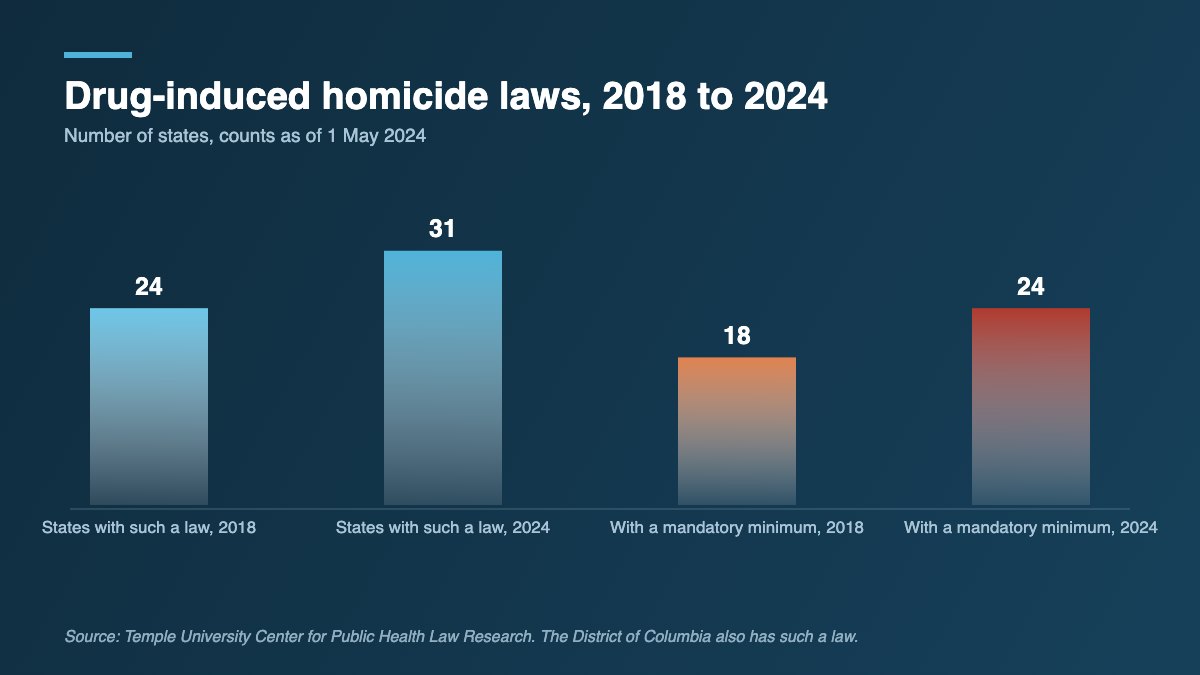
Temple University’s Center for Public Health Law Research, using its legal mapping dataset, reported that as of 1 May 2024, 31 states plus DC had a drug-induced homicide or drug-delivery-resulting-in-death statute, a 33 percent increase from 24 states in 2018.
You will see lower figures elsewhere, commonly 23 to 26. The discrepancy is definitional: some counts include only dedicated statutes, while others also count states that reach the same result through felony murder or manslaughter theories applied to overdose deaths. About two thirds of states is the range best supported across sources.
Sentencing severity rose alongside coverage. States attaching a mandatory minimum to the offense went from 18 in January 2018 to 24 by May 2024. Four states, Arizona, Colorado, Florida and Oklahoma, authorize a death sentence on conviction.
Who actually gets charged
The stated purpose of these laws is to reach dealers. The available case review suggests the practice is broader.
Analysis by the Health in Justice Action Lab of more than 200 prosecutions found roughly half involved a friend, family member, partner or caretaker of the deceased. In practice, the person charged is often whoever was present, whoever shared, or whoever sent the last text message, because those are the people investigators can identify.
On volume, the clearest historical figure comes from a tally built from media reports: prosecutions rose more than 300 percent in six years, from 363 in 2011 to 1,178 in 2016. We could not locate a comparable national count for any period after 2016, so we are not going to estimate one. That gap in the public record is itself notable for a category of prosecution that has expanded in 31 states.
The case supporters make
The argument for these laws is not frivolous and deserves stating plainly. Supporters hold that supplying a substance that kills someone is a serious harm that ordinary drug-distribution charges under-punish; that families of people who died are entitled to see the death treated as a death rather than a possession offense; that the threat of a homicide charge gives prosecutors leverage to move up a supply chain; and that the presence of fentanyl in a product the buyer did not ask for is a meaningful aggravating fact.
Prosecutors also argue that charging discretion filters out the sympathetic cases, and that reviews drawn from media coverage over-represent the unusual ones.
What the evidence shows
We found no systematic empirical evidence that drug-induced homicide prosecutions reduce drug selling or overdose deaths. Researchers at Temple’s center, the Health in Justice Action Lab and the Drug Policy Alliance state that increases in arrests and punishment severity for drug offenses generally show no deterrent effect on use or sales, and that no study demonstrates these laws slow drug markets or prevent subsequent overdoses.
Absence of demonstrated effect is not the same as demonstrated absence of effect, and deterrence is genuinely hard to measure. But after six years of rapid expansion, the evidentiary record supporting the policy remains empty.
The 911 problem
The most consequential concern is about bystander behavior. Fear of police involvement is the most frequently cited reason people do not call 911 during an overdose. Researchers argue that a visible risk of a homicide charge compounds that, and note that in roughly half of reviewed cases the person charged was someone close to the deceased, which is precisely the person most likely to be in the room.
This is presented in the literature as a plausible mechanism rather than a quantified causal effect on call rates, and we would characterize it the same way.
The legal interaction matters here. As of 2025, all 50 states and DC have some form of overdose Good Samaritan law, after Wyoming enacted one in its 2025 session; a 2021 federal audit had found 47 states plus DC. But only six states provide an affirmative defense specifically protecting a 911 caller from a drug-induced homicide charge. In most states, Good Samaritan immunity covers a possession charge and does not extend to homicide liability. A person who calls for help can be protected from the lesser charge and exposed to the greater one.
What to take from this
- Thirty-one states and DC have drug-induced homicide statutes, up from 24 in 2018. Lower counts elsewhere reflect narrower definitions.
- States attaching mandatory minimums rose from 18 to 24 over the same period. Four states authorize a death sentence.
- In a review of more than 200 cases, about half of those charged were a friend, partner, caretaker or family member of the deceased.
- Prosecutions rose from 363 in 2011 to 1,178 in 2016. No reliable national count exists for the years since.
- No study has demonstrated that these laws deter drug selling or reduce overdose deaths.
- All states now have overdose Good Samaritan laws, but only six shield a caller from a drug-induced homicide charge specifically.
For background on the substances most often involved, see our drug information library and the page on fentanyl.
Sources
This article relies on legal mapping and analysis from Temple University’s Center for Public Health Law Research, case review by the Health in Justice Action Lab at Northeastern University, a 2021 Government Accountability Office report on Good Samaritan laws, and state legislative records. Prosecution counts before 2016 derive from a media-report tally and should be read as an order of magnitude rather than an official statistic.
Need help now? In an emergency call 911. If you are in crisis or thinking about suicide, call or text 988 (Suicide and Crisis Lifeline; veterans press 1). For free, confidential treatment referrals 24 hours a day, call the SAMHSA National Helpline at 1-800-662-4357. You can also search licensed programs at FindTreatment.gov, or use our rehab directory and state listings.
Addiction Now publishes health journalism and reference material. This page is not medical advice, a diagnosis, or a treatment plan. Do not stop a prescribed medication without talking to a clinician. Withdrawal from alcohol, benzodiazepines and barbiturates can cause seizures and can be fatal without medical supervision.