

When pandemic era Medicaid protections ended in 2023, states began redetermining eligibility for everyone on their rolls. More than 25 million people were disenrolled. A study published in 2025 found that in the states that disenrolled most aggressively, people on buprenorphine lost days of active medication, which is the measure that predicts whether treatment holds.
What the unwinding was
Federal law had required states to maintain continuous Medicaid enrollment during the public health emergency in exchange for enhanced funding. That requirement ended in 2023, and states resumed checking eligibility. The process became known as the unwinding.
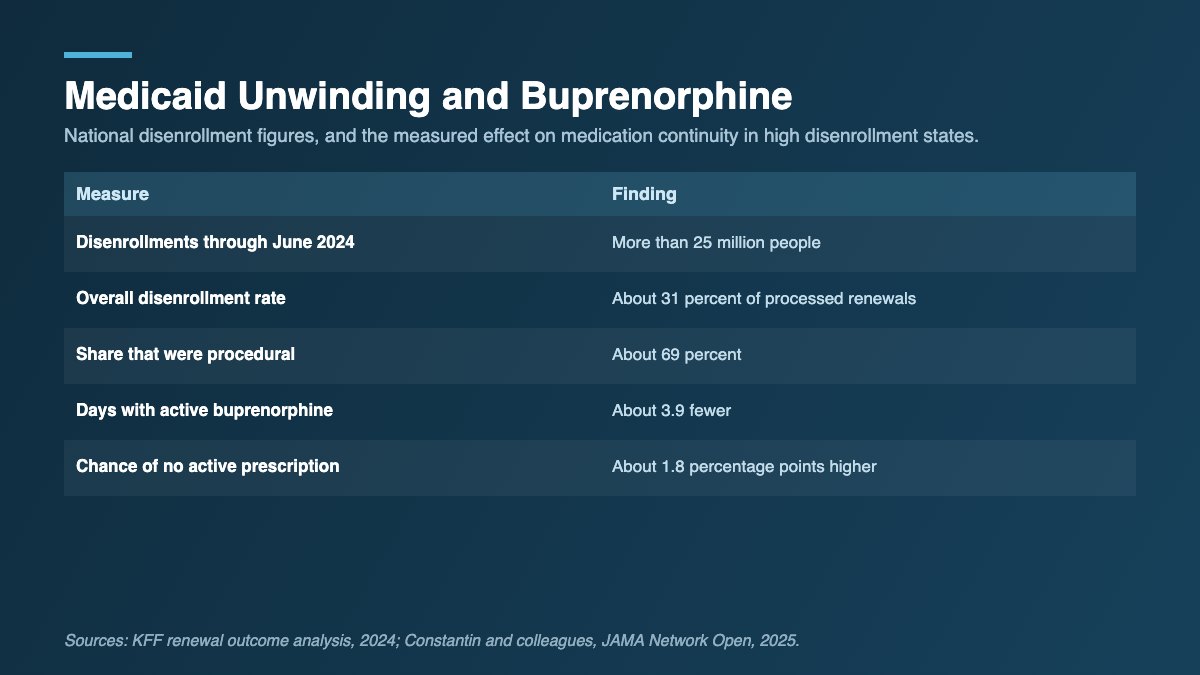
By the count kept through June 2024, more than 25 million people had been disenrolled, an overall disenrollment rate of roughly 31 percent among those whose renewals were processed. The detail that matters most is that around 69 percent of those disenrollments were procedural. Procedural means the state did not establish that the person was ineligible. It means paperwork was not returned, or an address was stale, or a form was not processed. Many of those people remained eligible.
Why buprenorphine is a good place to look
Most coverage of the unwinding measured coverage. Coverage is an input. What you want to know is whether losing it interrupted care that was working, and buprenorphine is unusually well suited to answering that, for two reasons.

First, it is dispensed through pharmacies, so there is a national prescription record that does not depend on a survey or a clinic chart. Second, its benefit depends on continuity in a fairly direct way. A gap in buprenorphine is not a missed check up. It is a return of withdrawal and craving, often within a day or two, in a person whose tolerance has changed.
What the study found
Researchers compared states with high disenrollment rates against states with lower ones, looking at buprenorphine dispensing before and after the unwinding began. In the high disenrollment states, patients had about 3.9 fewer days with an active buprenorphine prescription, and their probability of having no active prescription at all rose by roughly 1.8 percentage points.
Those are not dramatic numbers and they should not be inflated. Averaged across a large population they represent a meaningful volume of interrupted treatment, and the direction is unambiguous. What the study measures is dispensing, not outcomes; it does not report overdoses or deaths attributable to those gaps, and nobody should claim it does.
The procedural point is the policy point
If the disenrollments had mostly reflected people who genuinely no longer qualified, this would be a story about eligibility rules. Because most were procedural, it is a story about administrative design: renewal notices sent to old addresses, short response windows, forms requiring documents people did not have, and call centres that could not absorb the volume.
That distinction matters because the remedies are different and much cheaper. Automatic renewal using data the state already holds, longer response windows, and text message rather than postal notification all address procedural loss without changing who is eligible for anything.
What it suggests about coverage transitions generally
The unwinding was unusual in scale but not in kind. People move between Medicaid, marketplace plans, employer coverage and no coverage constantly, and every one of those transitions is an opportunity for a medication to lapse. A treatment whose effectiveness depends on daily continuity is structurally exposed to an insurance system built around monthly and annual eligibility cycles.
For related coverage of how Medicaid shapes what treatment is actually available, see our reporting on Medicaid coverage of residential addiction treatment and the wider drug information section.
If your coverage lapsed while you were in treatment
Two practical points follow from the procedural finding. The first is that a disenrollment for missing paperwork is often reversible. Most states operate a reconsideration period after a procedural termination during which returning the missing information restores coverage retroactively, without a new application. The window varies by state and is typically measured in weeks rather than months, so the timing matters.
The second is that a lapse in coverage does not have to mean a lapse in medication. Prescribers can often supply a bridge prescription, manufacturer and pharmacy discount programs apply to generic buprenorphine, and federally qualified health centres charge on a sliding scale regardless of insurance status. Telling the prescriber that coverage has lapsed, before the prescription runs out rather than after, is what makes those options usable.
Takeaways
- More than 25 million people were disenrolled from Medicaid through June 2024 as pandemic era continuous enrollment ended.
- About 69 percent of those disenrollments were procedural, meaning ineligibility was never established.
- In high disenrollment states, patients had roughly 3.9 fewer days of active buprenorphine and a 1.8 percentage point higher chance of no active prescription.
- The study measures dispensing, not overdose outcomes. Do not extend it further than that.
- Because the losses were procedural, the fixes are administrative rather than legislative.
Sources
KFF analysis of Medicaid renewal outcomes and enrollment changes at the end of the unwinding, 2024; Constantin and colleagues, Medicaid unwinding and changes in buprenorphine dispensing, JAMA Network Open, 2025; Centers for Medicare and Medicaid Services guidance on renewal and redetermination procedures.
Need help now? In an emergency call 911. If you are in crisis or thinking about suicide, call or text 988 (Suicide and Crisis Lifeline; veterans press 1). For free, confidential treatment referrals 24 hours a day, call the SAMHSA National Helpline at 1-800-662-4357. You can also search licensed programs at FindTreatment.gov, or use our rehab directory and state listings.
Addiction Now publishes health journalism and reference material. This page is not medical advice, a diagnosis, or a treatment plan. Do not stop a prescribed medication without talking to a clinician. Withdrawal from alcohol, benzodiazepines and barbiturates can cause seizures and can be fatal without medical supervision.