


In February 2024 the federal government rewrote the rules governing methadone treatment for the first time in more than two decades. Two years on, the reform has not changed access as much as its supporters expected, and the reason is built into the design: the rule permits flexibility rather than requiring it.
What the rule actually changed
The revised 42 CFR Part 8 was published in the Federal Register on 2 February 2024, took effect on 2 April 2024, and carried a compliance date of 2 October 2024. It replaced a framework substantially unchanged since 2001.
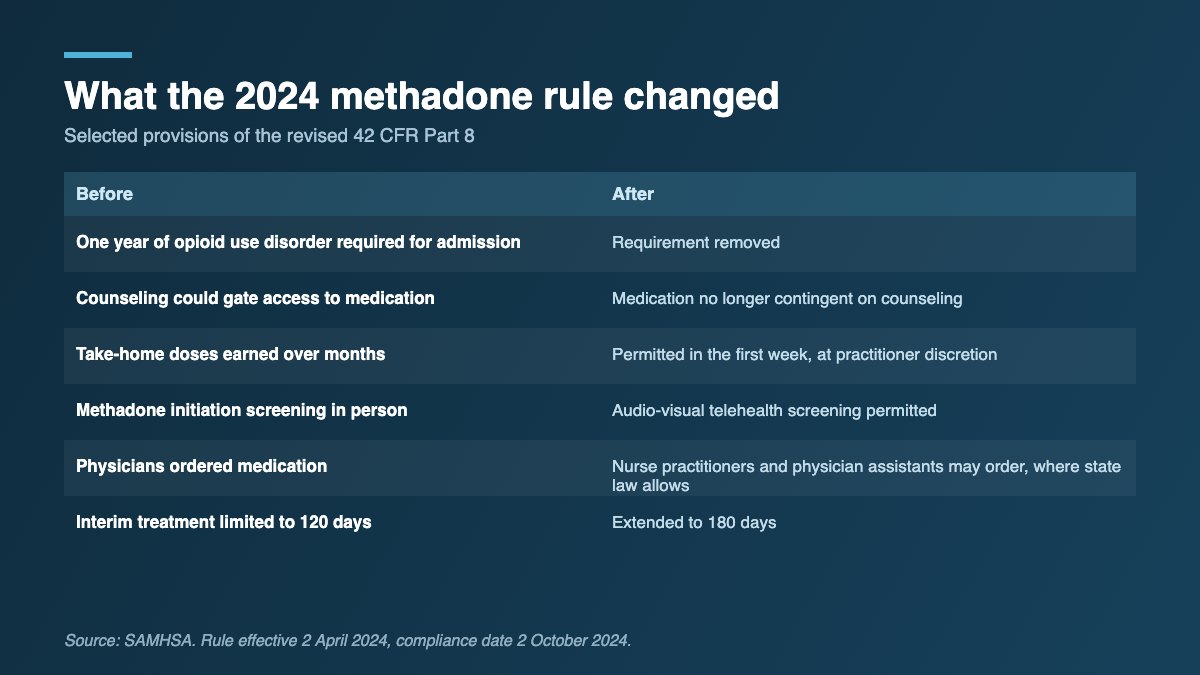
The headline changes were structural. The requirement that a patient document a full year of opioid use disorder before admission to an opioid treatment program was removed. For patients under 18, the requirement of two documented unsuccessful treatment attempts was dropped in favor of parent or guardian consent. Access to medication is no longer contingent on the patient receiving counseling, which had functioned in some programs as a condition of dosing.
Take-home dosing was the change that drew the most attention. The pandemic-era flexibilities, which allowed programs to send patients home with multiple doses rather than requiring daily supervised consumption, were made permanent, and take-home doses became permissible within the first week of treatment rather than after months of demonstrated stability.
Several other provisions matter more than their length suggests. Methadone initiation may now be screened by audio-visual telehealth, though not by audio alone; buprenorphine initiation may be screened by either. Nurse practitioners and physician assistants may order medication at an opioid treatment program where state law allows it. The window for interim treatment expanded from 120 days to 180. And the regulation replaced the word “detoxification” with “withdrawal management,” a terminology change that reflects a decade of clinical argument about what the older word implied.
Permissive, not mandatory
Here is the mechanism that explains the gap between the reform and the experience of patients.
Federal regulation sets an outer boundary on what an opioid treatment program may do. It does not set a floor on what a program must offer. When the rule says a practitioner may authorize take-home doses in the first week based on clinical judgment, the operative words are “may” and “judgment.” A program that preferred daily supervised dosing before April 2024 is free to continue preferring it.
Three further layers sit on top. State law can be more restrictive than federal law, and in several states it is. State methadone authorities impose their own conditions on programs they license. And individual programs carry their own liability calculations, diversion-control policies and staffing constraints, any of which can make the conservative option the default.
The result is that two patients with identical clinical presentations, in adjacent states or even in the same city, can encounter very different dosing regimes, both fully compliant with the same federal rule.
The scale involved
SAMHSA reports that it supports the certification and accreditation of more than 1,900 opioid treatment programs, which together treat more than 600,000 patients each year. That figure covers patients receiving methadone, buprenorphine and naltrexone at those programs rather than methadone alone, so it should not be read as a methadone census.
It is worth holding that number against the geography. Methadone in the United States can generally be dispensed only through a certified opioid treatment program, which means access is a function of whether such a program exists within daily traveling distance. For a treatment that in many programs still requires showing up every morning, that constraint does more to determine who gets methadone than any provision of the rule.
An administrative question hanging over it
In March 2025 the Department of Health and Human Services announced a reorganization that would fold SAMHSA into a new Administration for a Healthy America alongside several other agencies. SAMHSA has continued to maintain guidance on the rule, and its frequently asked questions page was updated as recently as March 2026, so the regulation itself is operating normally.
What a reorganization does to certification, accreditation oversight and technical assistance capacity is a reasonable question, and not one that can be answered from published documents yet. We note it because the machinery that enforces a rule matters as much as the text.
Questions worth asking a program
- What is your policy on take-home doses in the first month, and what specifically would need to be true for me to receive them?
- Is counseling a condition of receiving my medication here, or is it offered alongside it?
- Can any part of my intake or ongoing care be done by telehealth?
- Who at this program can order or adjust my dose, and how quickly can that happen?
- If I need to travel, what is the process for guest dosing at another program?
Programs answer these differently, and the answers are a fair proxy for how the program reads its own discretion. For background on the drugs involved, see our drug information library and the pages on fentanyl and oxycodone.
What to take from this
- The 2024 rule was a genuine liberalization: no one-year history requirement, no counseling precondition, take-home doses possible in week one.
- Every one of those provisions is permissive. Programs may adopt them and are not obliged to.
- State law and individual program policy sit on top of the federal rule and can be more restrictive.
- More than 1,900 opioid treatment programs serve more than 600,000 patients a year across all three medications.
- Geography remains a hard constraint, because methadone is generally dispensed only through certified programs.
- If a program’s practice seems more restrictive than the rule requires, that is worth asking about directly, because it often is.
Sources
This article relies on the Federal Register text of the 2024 final rule revising 42 CFR Part 8, SAMHSA’s published summary of changes and provider guidance, and the March 2025 Department of Health and Human Services announcement on agency reorganization. Program and patient counts are as published by SAMHSA and reflect that agency’s most recent update.
Need help now? In an emergency call 911. If you are in crisis or thinking about suicide, call or text 988 (Suicide and Crisis Lifeline; veterans press 1). For free, confidential treatment referrals 24 hours a day, call the SAMHSA National Helpline at 1-800-662-4357. You can also search licensed programs at FindTreatment.gov, or use our rehab directory and state listings.
Addiction Now publishes health journalism and reference material. This page is not medical advice, a diagnosis, or a treatment plan. Do not stop a prescribed medication without talking to a clinician. Withdrawal from alcohol, benzodiazepines and barbiturates can cause seizures and can be fatal without medical supervision.